
























Jul 26, 2026
The Question in the title South Australia’s Minister for Health and Chief Psychiatrist, Dr John Brayley, Must Answer About Psychiatric Practices in South Australia
Psychiatrist: “The decision has been made … to treat you if there is psychosis.”
PJ: “Then why is that? What makes me psychotic?”
Psychiatrist: “That’s why this further assessment is needed.”
Those few words may become some of the most significant evidence in PJ’s legal proceedings against the State of South Australia currently lodged at the Supreme Court of South Australia.[1]
If accurately reflected in the recording relied upon by PJ, they raise a question that extends well beyond one woman’s case, “Can a person be diagnosed, medicated and detained before the assessment used to justify those decisions has even been completed?”.
PJ says the answer, in her case, was “Yes”.
“Australia maintains anti-corruption commissions, ombudsmen, integrity agencies, auditors, and oversight bodies in every jurisdiction. Their existence is an acknowledgement that misconduct and maladministration can occur. The proposition that concern about governmental misconduct is itself evidence of mental illness should concern every Australian.”
Dee McLachlan, Human Rights Advocate
If her allegations are ultimately established, they expose something far more concerning than an error in clinical judgement. They raise questions about whether psychiatry was used not merely as healthcare, but as an instrument that facilitated one of the State’s most coercive powers – the permanent separation of a mother from her child.
Dr Chaminda Mahesha Rajasuriya, Psychiatrist, is accused by PJ of contriving her diagnosis Bi-Polar on 3rd and 4thMay 2023 at Berri Hospital, after she was twice detained without just cause. Particia did complain to AHPRA on 29/5/23 (Ref #00528963), but the complaint was “buried” and received no response, so another was lodged on 1/7/26 (Ref #14666305).
For a decent chronology of events, see “PJ : A LETTER TO THE SOUTH AUSTRALIAN PREMIER, POLICE COMMISSIONER & DEPT FOR CHILD PROTECTION”.
A Mother’s Story Begins Long Before the Hospital
PJ is not simply a current psychiatric patient. In fact, before August 2019, PJ had no history of mental illness, no label, no diagnosis.
PJ was a former Victorian court security officer who worked throughout courts, hospitals, Parliament House and other public institutions. During that time, she says she witnessed conduct she believed amounted to serious institutional wrongdoing. Those experiences eventually led her to make public-interest disclosures, including communications with the Yoorrook Justice Commission immediately before the events that would change her life. PJ has been a political activist on a variety of social justice causes and observes Sacrogeny, Ontology, Cosmology, Ethnogenesis and Ancestriology, among other things.
In late April 2023, PJ was travelling with her four-year-old child, KG, after attending part of a pilot training course. She says they were camping by choice while travelling through South Australia.
On 1 May 2023 she communicated with the Yoorrook Justice Commission.
On 2 May 2023 a notification was transmitted from Victorian Department of Child Protection Services (DCPS) to the South Australian Department for Child Protection (DCP) authorities that PJ was allegedly “fleeing” the State of Victoria. This lie was significant in triggering a massive State intervention because PJ was never under any detention orders of any kind. She was a free agent travelling across state borders, however, the lie painted a narrative that would stick, regardless of truth.
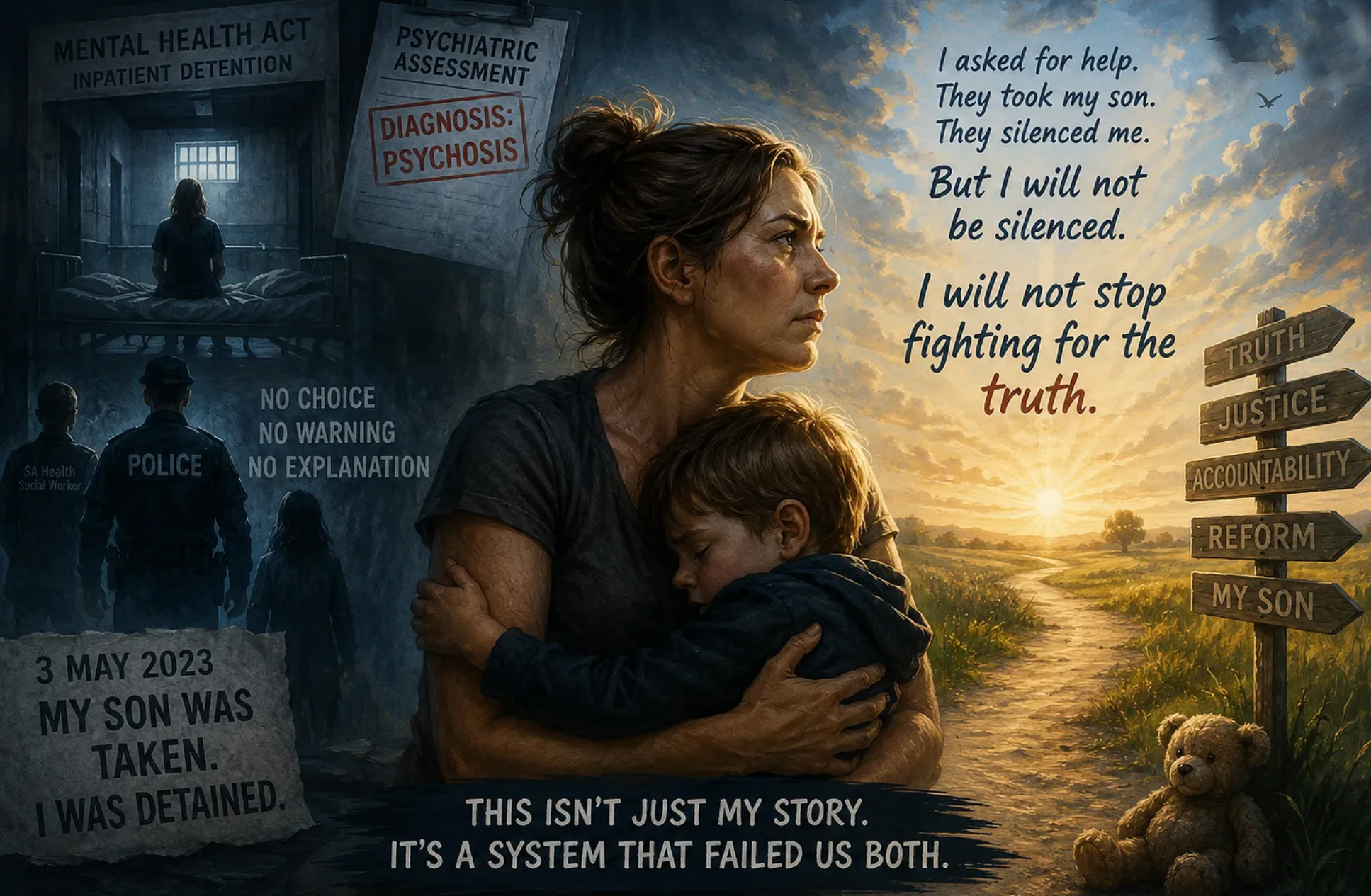
On 3 May 2023 everything changed. PJ would later discover that a story was concocted by SA Ambulance Service (SAAS) to advise her that there was a “000” call out to Renmark shopping centre made on 2nd May 2026. This story was made up to cover up the collusion between SAAS and SA Police, which was already in attendance at the shopping centre on 3rd May 2023 and had removed PJ’s car keys unlawfully, informing her that she could not leave until ambulance had arrived. At the time, police questioned PJ about phone calls she had allegedly made but did not specify to whom and about what.
Soon after arriving, SAAS took PJ and her child to a nearby park, with Police in tow. DCP then arrived and distracted PJ, while SAAS took the child to the river. When DCP left, SAAS advised they would be taking PJ to the Berri Hospital, concealing their intention to conduct psychiatric evaluation.
After a few hours, PJ took her child and left the hospital despite being told by SAAS “You can’t leave”. PJ said, “Watch me!”.
SAAS then pulled up behind PJ’s as she was on foot, having stopped a pedestrian for directions. As Police had keys to Particia’s car, PJ went then walked to AC Care (an Indigenous Foster Care service and local welfare agency) to search for witnesses for events which transpired a day earlier (on 2/5/23), having told staff that she believed her child would be kidnapped due to disclosures she had made to the Justice Commission of Victoria and needed witnesses. Within minutes of her arrival, her child was taken by SA Police which passed the child on to DCP. The child was screaming while PJ was beaten and knocked unconscious. One Police officer said, “You’re white and shouldn’t be here [at AC Care]”. Another said, “We can do this the easy way or the hard way”, while PJ and her child were holding on to each other.
This was the last time PJ saw her child.
The Psychiatric Intervention by SA Health
PJ was located by police, forcibly transported by ambulance and was detained under the Mental Health Act 2009 (SA). Her four-year-old child was removed from her care.
These events form the foundation of PJ’s Supreme Court proceedings. The central legal issue identified in her pre-action claim is not whether authorities eventually formed concerns about her mental health, but a narrower question:
What contemporaneous objective facts existed before coercive powers were exercised?
That distinction matters.
The legality of detention depends upon information available when liberty is taken away – not information gathered days, weeks or months afterwards.
“What Makes Me Psychotic?”
The most remarkable aspect of PJ’s account concerns what occurred the following day.
She had secretly recorded her psychiatric assessment at Berri Hospital.
According to her proposed claim, she repeatedly asked the treating clinician a simple question, “What makes me psychotic?”.
Instead of identifying objective clinical findings, PJ alleges that discussion focused upon her beliefs regarding police conduct, government corruption, child protection authorities and the removal of her son.
Her pleading quotes the exchange:
Dr Rajasuriya, “The decision has been made … to treat you if there is psychosis.”
PJ replied, “Then why is that? … What makes me psychotic?”.
Dr Rajasuriya responded, “That’s why this further assessment is needed.”
If accurately reproduced from the recording, the sequence appears unusual.
It suggests PJ was told treatment had effectively been decided before the assessment relied upon to justify that treatment had concluded.
The sequence described in PJ’s account is difficult to reconcile with what most members of the public would reasonably expect from a government decision-making process. Ordinarily, people would expect an objective assessment to precede a decision to diagnose, detain or impose compulsory treatment – not for the need for an assessment to be explained after a decision to treat has already been communicated. If the conversation accurately reflects what occurred, it naturally raises questions about whether the assessment process was genuinely open-minded or whether the conclusion had effectively been reached in advance.
Government decision-making is expected to proceed from evidence to conclusion. The concern raised by PJ’s account is that the process appears to have operated in the opposite direction: a conclusion that compulsory treatment was warranted appears to have preceded the assessment said to justify it. Whether that appearance is ultimately borne out by all the evidence is a matter for legal proceedings, but it is a sequence that many reasonable people would regard as warranting close scrutiny.
In August 2019, while her child was an infant, for the first time ever, PJ was admitted to a psychiatric ward in Victoria after an incident in which authorities reportedly found her in a park with her child, however, by the time all this was resolved, PJ was stuck with a label of alleged “Bi-Polar”.[2] [3]
Four years later, the South Australian Department for Child Protection relied on this August 2019 episode as part of the background to its 2023 application concerning the child. The accompanying critique argues that the 2019 incident had already been investigated and resolved through reunification, and therefore should not, without more, have been treated as automatically re-establishing a statutory basis for intervention in 2023. It also questions whether references to historical diagnoses and events were presented as verified contemporaneous evidence or merely as historical reports, emphasising that the application repeatedly described several matters as “reportedly” occurring or still requiring “investigation and assessment.”
Fast forward to 27th July 2025, PJ was put onto forced Community Treatment Orders (CTO). One of the reasons cited for the CTO by Psychiatrist, Dr Chitrarasu, was that PJ was “pre-occupied with Government agencies being corrupt”.
When Reality Becomes “Psychosis”
PJ says the discussion soon shifted. She alleges that her concerns about institutional misconduct – including what had happened to her child only hours earlier – were interpreted as evidence of psychosis.
According to her pleading, the psychiatrist stated: “Your fears about the child… probably represents some psychotic thinking.”
PJ answered, “No, it’s not … You took my son.” Later she responded, “You’re involved with ripping my child from my arms. I don’t call that conspiracy, that’s a fact.”
This is perhaps the central controversy.
PJ’s case is not simply that she disagreed with clinicians. Her case is that actual events which had already occurred – the removal of her child and her interaction with public authorities – were allegedly interpreted as symptoms of mental illness rather than examined as factual matters capable of independent verification.
Still on the topic of lawfare, health and soviet psychiatry – a slight digression but all related at the core by the jewish communist manifesto to destroy [especially White] families et cetera…
• The Dutch lawyer who charged Bill Gates et al with bioterrorism and crimes against humanity has been arrested – Shameless_Wiseass FTJ
https://ftjmedia.com/watch/the-dutch-lawyer-who-charged-bill-gates-et-al-with-bioterrorism-and-crimes-against-humanity-has-been_F532rz3D6vmaZuX.html
• Shiloh’s defense lawyer – Shameless_Wiseass FTJ
https://ftjmedia.com/watch/shiloh-039-s-defense-lawyer_4tgKnHCVs9OTE7S.html
featured in a full discussion here with Tonitrus …
• Diēs Sōlis -111- Shiloh Hendrix guilty in USA merging its military with Israel – Tonitrus FTJ
https://ftjmedia.com/watch/di-s-s-lis-111-shiloh-hendrix-guilty-in-usa-merging-its-military-with-israel_7367cb2649794f9eb432.html
The collusion is a symptom of madness. Can I prove that with a blood test or scan, no I can’t anymore than any of the Doctors.To imply anything from a questionnaire is really sick, to act on it is mentally retarded.
Last time I had collusion, was multiple welfare checks containing clear trespass. Didn’t bother me as I was on home ground. Funny they never asked how I was feeling, guess I can look sharp eye’d yet calm with a child at foot. I’ve seen and experienced “intimidation” previously to that, call me crazy but I knew what I could be dealing with after that forced red pill.
Trust government.
Trust experts💁
Trust bureaucrats.
Trust authority.
Trust a politician?
Trust doctors.
Trust the ABC
Trust the globalist fake mass media.
Then go get another booster and trust you will be safe.
807
Please watch this video. It goes into considerable detail of the coming FAMINE. If you think the fights over toilet paper were crazy, just wait for the fights over FOOD.
https://beforeitsnews.com/war-and-conflict/2026/07/iran-war-fallout-silent-aftershocks-coming-mike-adams-lt-col-daniel-davis-video-2487714.html
I know where to go when i get hungry
💁🤪🤪🤪🤪
Some people must actually read my private email list.
Ta Terry, thought you would be interested.
Of course it came from BIN
947
Wonder if our fat lot in Canberra have taken any notice of the same email I sent to them linking Michael Adam’s. analysis.
Trust we must, that they will NOT starve first🤷♂️🤪
AFTER ALL, WE NEED SOME GRIFFIN PELICANS TO PREPARE THE NATION.
TRUst CANBERRA🙉🙈🙊🙀
1032
Not again censor! Comment missing
Clearly, you can be listed with those WE DO NOT TRUST.
937
2 comments. First: “PJ was put onto forced Community Treatment Orders (CTO). One of the reasons cited for the CTO by Psychiatrist, Dr Chitrarasu, was that PJ was “pre-occupied with Government agencies being corrupt”. Dear Dr Chitrrasu, I am in America. I am about as pre-occupied with gov’t corruption as anyone could be. (Read my books, they are in the Australian National Library, e.g.: Prosecution for Treason (2011), Fraud Upon the Court (2015), Get Up, Australia, Get Up [I’ma a dual citizen of US’] So come and get me. You must think I need CTO.
Second, for Dee’s valise, re Ms PJ: Dee, in US we have the Material Witness Act. It allows us to arrest, say, Tony Fauci, without having any indication of crime done by him. The point is he may escape with valuable evidence. Normally due process would protect him EVEN from detention — and indeed he won’t be wrongly detained if he coughs up the evidence we are seeking.
So I am recommending to you that the detaining of PJ could be (on a stretch) considered OK while they check out whatever it is they supposedly need to check out, including her health, BUT OF COURSE NOT INJECT HER WITH…
LONG STORY SHORT THERE IS NO EXCUSE WHATSOEVER TO GIVE HER A PRE-DIAGNOSIS SHOT.
Agreed, NONE even for typhoid. If an adult wants to shoot Microsoft monkey kidneys, right into their veins and know the effects, fine.
Even if we were to extradite you, you would be disallowed entry based on your free speech, sister. And lordy knows we have already paid the tariff-wink