



















by Matilda Bawden (Human Rights Advocate / Citizen Journalist)
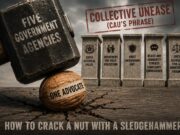
HOW MANY GOVERNMENT AGENCIES DOES IT TAKE TO DESTROY ONE ADVOCATE?
To the Chief Executive
Department of Human Services
South Australia
and
The Central Assessment Unit (CAU)
Screening Unit
Department of Human Services
27 August 2026
Dear Chief Executive and Central Assessment Unit,
An Open Letter to the Department of Human Services, Central Assessment Unit
Re: Preliminary Working With Children Prohibition Notice — RRN-01176820
Apparently one South Australian government agency coming after my professional credentials was not enough.
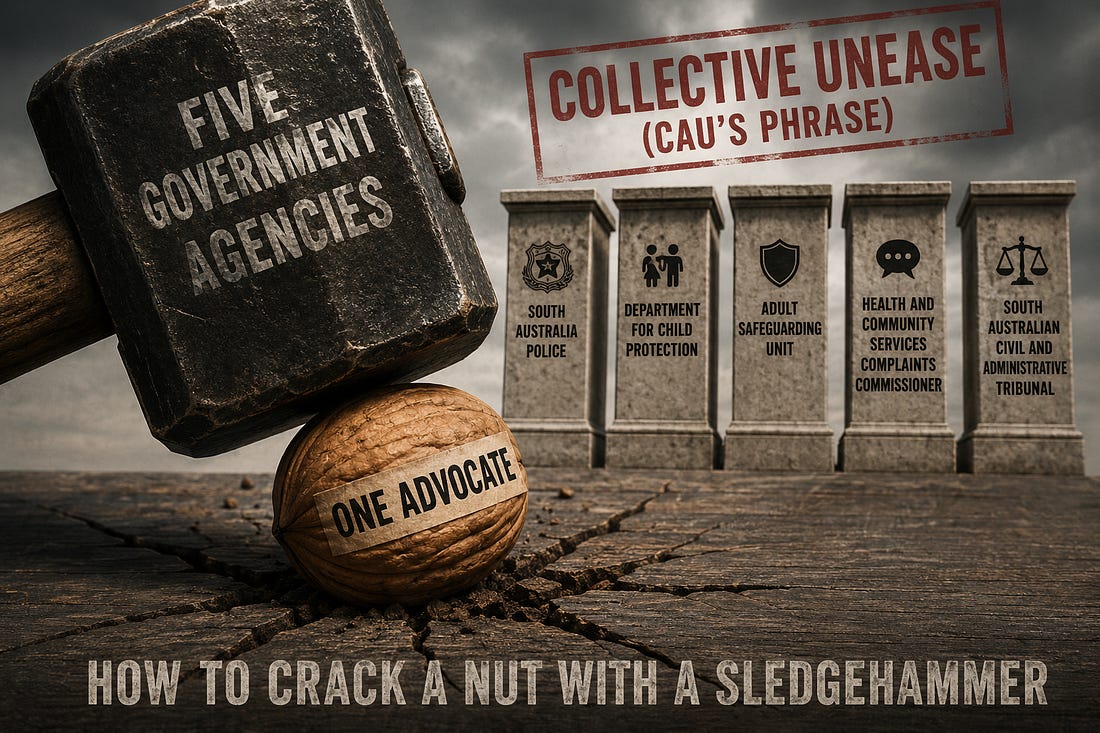
Now we have five!
On 10 August 2026, I received an extraordinary 13-page document from the Department of Human Services’ Central Assessment Unit (CAU) advising me that it has formed a preliminary view that I pose an “unacceptable risk to children.”
This came less than four months after the very same Central Assessment Unit conducted a Working With Children Check and, on 24 April 2026, determined that I was NOT PROHIBITED from working with children.
What happened in those few months?
According to the Department, it received “new information”.
And where has the case against me now come from? Which agency initiated the “new information” exchange after I was cleared on 24 April 2026?
The Department’s own document identifies information supplied by:
· South Australia Police.
· Department for Child Protection.
· Adult Safeguarding Unit.
· Health and Community Services Complaints Commissioner.
· South Australian Civil and Administrative Tribunal.
Five arms of the South Australian State have now been assembled into a single document to construct a case that I am somehow a prospective danger to children.
And after years of challenging government agencies over the treatment of vulnerable South Australians, in guardianship, in institutional detention, concerning informed consent, regarding disability rights and government accountability, I am now told that even my tendency to “question or challenge the status quo” is a relevant “variable” in determining whether I should be permitted to work with children.
Seriously?
At what point does regulatory scrutiny become institutional persecution?
At what point does information-sharing between government agencies become the construction of a government dossier against a troublesome advocate?
And at what point does somebody in authority finally ask, “What exactly has Matilda Bawden done to a child?”.
Because after reading thirteen pages supposedly establishing that I present an “unacceptable risk to children”, that remarkably simple question remains unanswered.
Most significantly, not one parent, legal guardian or identified first-hand witness is said in this Notice to have complained that I harmed, abused, neglected or otherwise endangered a child through my relationship with that child, my conduct around that child, or my advocacy for that child or their parent/guardian. Not even one!
Instead, I am confronted with reports, referrals, institutional opinions, adult safeguarding allegations, adult guardianship proceedings, an HCSCC prohibition order, police information that resulted in no charge, and allegations which the CAU itself acknowledges are unsubstantiated and unproven.
If the Department possesses a complaint from a parent, guardian, child or first-hand witness alleging that I actually harmed a child, produce it.
Identify the child. Identify the alleged conduct. Identify when it occurred. Identify the person who witnessed it. Identify the harm allegedly caused and give me a proper opportunity to answer it.
Otherwise, the obvious question remains: WHAT CHILD HAVE I HARMED?
Let us begin with the obvious.
· Where is the child whom I have assaulted?
· Where is the child whom I have abused?
· Where is the child whom I have neglected?
· Where is the criminal conviction involving a child?
· Where is the charge?
· Where is the substantiated finding?
· Where is the judicial finding that I have harmed a child?
· Where is the established conduct from which a rational prediction can be made that I am likely to cause serious harm to a child in the future?
Instead, I am presented with a sprawling institutional collage extending back more than a decade.
· Allegations
· Reports
· Opinions
· Disputed characterisations
· Adult safeguarding matters
· NDIS disputes
· A COVID-era HCSCC prohibition order
· Adult guardianship proceedings
· My advocacy before SACAT, and apparently
· My troublesome habit of questioning authority.
These things have been placed into one enormous bureaucratic blender and poured out under the label: “UNACCEPTABLE RISK TO CHILDREN.”
That is not good enough! Where is the institutional accountability?
THE DEPARTMENT ADMITS THE CASE IS UNPROVEN
Perhaps the most extraordinary feature of this document is that the Department itself acknowledges the weakness of significant parts of its evidentiary foundation.
The CAU expressly acknowledges that information obtained from DCP and the Adult Safeguarding Unit remains “unsubstantiated” and “unproven.”
It acknowledges that the SAPOL material has not proceeded to formal charge.
It acknowledges that the 2025-26 SACAT proceedings “were not an inquiry into [my] alleged conduct.”
Read that again!
Unsubstantiated.
Unproven.
No charge.
Not an inquiry into MY CONDUCT!
And yet these materials are collectively being used to contemplate stripping me of my Working With Children clearance.
This is apparently what passes for procedural fairness in South Australia in 2026.
AN ALLEGATION DOES NOT BECOME TRUE BECAUSE GOVERNMENT REPEATS IT
There is a sentence buried in this document which should disturb anyone concerned about administrative justice.
The CAU says: “The presence of these reports verifies the veracity of the related concerns.”
No. It does not. The existence of a report proves that a report exists. It does not prove that the allegation recorded in that report is true at all! And an allegation does not magically acquire evidentiary weight merely because it travels around government.
NDIA gives ASU allegation A. ASU picks up an allegation with DCP/OPA, which records allegation A. ASU reports allegation A to NDIS Quality and Safeguards Commission and other regulators (e.g., HCSCC, NDIS Fraud Unit). Agency number four records that agencies one, two and three have concerns about allegation A. We now have at least four records.
We do not have four pieces of independent evidence!
We may still have just one allegation.
This distinction should be elementary to any public authority exercising coercive power over another person’s livelihood and reputation.
Instead, bureaucratic repetition appears capable of becoming bureaucratic corroboration.
“POLICE SAID SO” IS NOT AN EVIDENTIARY ANALYSIS
In relation to one disputed incident, the CAU announces that it accepts the SAPOL account because: “police officers are a reliable and credible source of information.”
Really?
Not because the particular evidence has been independently tested.
Not because competing accounts have been examined.
Not because documentary evidence demonstrates that the police account is correct.
Police are believed because police are police.
That is not an assessment of evidence.
That is an institutional presumption.
Police officers can be mistaken.
Government officers can be mistaken.
Social workers can be mistaken.
Doctors can be mistaken.
Tribunal members can be mistaken.
Regulators can be mistaken.
That is precisely why procedural fairness must be seen to exist.
Further, I suspect Adult 2’s son [an adult himself at the time!] would beg to differ with your premise about Police, since Police are denying disclosure of critical documents to the son about the events on the date in question in your communication. Our recorded evidence shows that:
1) I called police to deal with an aggressive and distressed gentleman who was unable to cope with his caring duties while he was posing a risk/danger to his wife.
2) No statement or threat of any kind was made against me by Police regarding any risk of “trespass” at the time.
3) I was at the premises with Dr Kathleen Maros’s full knowledge and consent.
4) I left of my own volition after a conversation with police and providing them with all the information available to me at the time.
5) The son has already flagged the events on this day for investigation with the Crown Solicitor and he is considering possible further legal action against Police. Legal advice suggests an action against the State is compelling.
In fact, the events of that day precipitated a sequence of events that led directly to the death of Dr Kathleen Maros in State Care: https://substack.com/@matildabawden/p-168403761 .
So, contrary to the notion that “police officers are a reliable and credible source of information”, I’d suggest the police bungled badly on this occasion.
Importantly, the Police report gets even worse. A purported event reported by Police for 25th January 2023 provides no specifics. How am I supposed to respond with no particulars?
Did this incident concern an adult or child? Was a report made by an NDIS competitor? An NDIS provider poaching my clients? If it related to anything concerning NDIS services, those matters should have been reported:
a) Not reported to me
b) Not reported to the NDIS Quality and Safeguards Commission and/or
c) After “reporting”, there was no reason for any further investigation or follow up to answer, so I was never contacted.
WHO WROTE THIS DOCUMENT?
The covering correspondence bears only the first name “Jenna”, identified as a Senior Assessment Officer.
Jenna, odds are you did not write this document at all! I, therefore, require DHS to identify the author or authors of the 13-page Preliminary Notice and Reasons for Determination; every officer who materially contributed to its drafting; whether legal advice or drafting assistance was obtained; whether the Crown Solicitor’s Office was consulted or provided advice concerning this assessment; and whether any draft was provided to another government agency for comment before it was issued to me.
This matters because I am supposedly being invited to respond to the CAU’s preliminary reasoning. I am entitled to understand whose reasoning it actually is.
AND THEN WE ARRIVE AT MY “WORLDVIEW”
This is where the document moves from disturbing to extraordinary.
The CAU writes that my assessable information, “appears to have arisen in the context of a worldview that presents alternative ideas and reasoning that may question or challenge the status quo.”
What does that have to do with whether I am dangerous to children? Whose “status quo” are we measuring my “worldview” by?
What is my “worldview”?
I want to know whose “world view” I am supposed to be agreeing with! In fact, I want to know who actually even wrote this sentence into your correspondence, by name and title?
What “alternative ideas”? Which ideas are considered unacceptable? What “status quo” am I apparently insufficiently respectful of? Government? SACAT? The Public Advocate? SA Health? DCP? HCSCC?
That SACAT, OPA, ASU, HCSCC and other government authorities ought to be accountable and publicly transparent? That the same authorities ought to comply with the law? And since when did questioning the status quo become a variable in a statutory child-safety assessment?
Because I do question the status quo – constantly – and so should every regulatory authority!
I question government agencies when vulnerable people are being mistreated. I question hospitals when adults capable of expressing their wishes say they want to go home. I question guardianship systems, regulators, bureaucrats and tribunals. I question public officials exercising coercive power. I investigate, research, advocate and now I write and publish real-world experiences by real people, almost in real-time. The SA Government calls that the “Lived Experience”: https://www.chiefpsychiatrist.sa.gov.au/lived-experience .
And I will continue doing so!
That is not evidence that I am dangerous to children.
It is evidence that I am an advocate and dangerous to public officials who would prefer their conduct not be scrutinised, especially after they put people into nursing homes before their time, only to die alone and isolated in “State Care” months after they are removed from the loving care of their family members. I am a danger to Public Advocates who remove vulnerable people from their mothers when even three judges at the Full Supreme Court cannot identify the reason for the person’s removal and finding the reasons “unexplained”.
https://matildabawden.substack.com/p/a-system-in-crisis-why-the-michael
Clearly my criticism of South Australian government institutions has contributed heavily to this adverse assessment, and that is made abundantly clear in this correspondence.
Indeed, I document people’s Lived Experience so that Crown Law cannot gaslight the public of South Australia into thinking these human-interest stories are just “isolated cases”, “administrative anomalies”, “that was then; this is now”, “with the benefit of hindsight”, “unfortunate” cases…
WHEN DID ADVOCATING FOR ELDERLY PERSONS BECOME EVIDENCE OF DANGER TO CHILDREN?
A substantial component of this extraordinary document concerns my involvement in SACAT proceedings involving mature and elderly adults. Not a child!
The matters concerned capacity, an Advance Care Directive, an Enduring Power of Attorney, hospital discharge, guardianship and the person’s expressed opposition to residential aged care.
I advocated. I challenged. I filed material. I sought review. And somehow the DHS transforms my involvement in those proceedings into an alleged: “inability to adhere to policies, procedures, and guidelines put in place to protect the safety and wellbeing of vulnerable people, including children.”
There is a rather large, logical hole in the middle of that proposition.
Where are the children?
What established conduct concerning an elderly adult demonstrates that I present an unacceptable prospective risk of serious harm to a child?
What is the causal connection?
What is the evidentiary connection?
What is the reasoning?
Adding the words “including children” to the end of a sentence does not turn adult guardianship advocacy into child endangerment.
THE 2014 ABSURDITY
The Department reaches all the way back to 2014 to create a “Dirty File” full of nothingness.
It is alleged that a 14-year-old disclosed that she had been inappropriately touched by a neighbourhood resident. HOWEVER, that matter was reported to police and CARL and many other authorities at the time BY ME! I have copious proof of texts, emails and many also sent to Ministers, Shadow Ministers and Members of the SA Parliament proving that all of my best efforts to report were IGNORED BY THE STATE OF SOUTH AUSTRALIA! In fact, that “child” reports she was never believed by the Police, so charges were never pursued!
Fortunately for me and the “child” in question, all of this was recorded by me in immense detail at the time, and should have been recorded by every authority which I had approached for help to protect that minor. Instead, the State left her in crisis and almost destitute. Some of those witnesses were even Members of the House of Assembly in the SA Parliament too.
The CAU then acknowledges something rather important. I was not dealing with the child in an employment capacity and therefore I was not legally required to make the mandatory notification upon which the Department now focuses.
The absurdity is therefore doubled: not only does CAU acknowledge that I was not legally obliged to make a mandatory notification in those circumstances – I say I nevertheless reported the matter to Police, CARL and numerous other authorities, and I have the contemporaneous records to prove it.
So let us understand this.
The Department acknowledges that I did not breach the statutory mandatory-reporting obligation. It nevertheless uses that event, twelve years later, as a reason for questioning whether I should now be allowed to work with children.
By what standard?
If there was no statutory obligation, identify the obligation I breached.
Identify its source. Identify the conduct required of me. Then explain how my conduct twelve years ago rationally predicts that I pose an unacceptable risk to children today.
THE CHILD IN THE WHEELCHAIR – HOW DOES ONE DISPROVE AN EVENT THAT NEVER HAPPENED?
Among the allegations now presented to me is a false allegation that I restrained a child in a wheelchair. I categorically deny it. This never happened!
Indeed, I am confronted with the almost impossible task of disproving an alleged event which I say simply did not occur.
How exactly does one prove that an alien spacecraft did not land in one’s front yard? That is the evidentiary absurdity created when an allegation is presented without sufficient particulars and the person accused is effectively expected to disprove it.
I suspect I know the identity of the child to whom this allegation may refer. If I am correct, I was never that child’s Support Worker. I did not provide his physical support. I did not push his wheelchair. I did not restrain him. I did not physically handle him. Ever!
In fact, I do not presently recall ever being out with this child while he was using his wheelchair.
There is another important distinction which the CAU’s vague use of the word “restrained” completely obscures.
The child had been recommended a wheelchair by an Occupational Therapist. Wheelchairs may be fitted with positioning and safety equipment, including seatbelts. The mere use of such equipment does not, without more, establish that somebody subjected a child to an unlawful or unauthorised restrictive practice.
If CAU is actually alleging the misuse of a regulated restrictive practice, then say so. Was the allegation one of physical restraint? Mechanical restraint? What device was supposedly used? By whom? For what purpose? Was it allegedly used to manage behaviour, prevent movement, provide postural support, or simply for ordinary safety?
Those distinctions matter. The NDIS restrictive-practices framework itself distinguishes regulated restraint from ordinary safety measures according to their purpose, context and use.
To keep reading: Matilda’s Substack
‘So, contrary to the notion that “police officers are a reliable and credible source of information”, I’d suggest the police bungled badly on this occasion.’
They are reliable, I’ve been around awhile and can set my wrist-watch to their beat. Not just sapol but allpo, pretty much if I see services, I can chime, corruption and worse.
“South Australia Police.
· Department for Child Protection.
· Adult Safeguarding Unit.
· Health and Community Services Complaints Commissioner.
· South Australian Civil and Administrative Tribunal ‘
These are all headed by a person, push back on their head name. e.g hearsay and innuendo is the game, I’ll show you how.
https://en.wikipedia.org/wiki/Grant_Stevens_(police_officer)
This businessman regards people as a resource and happily restrained an entire state because he caught the flu and looks like he upped the ante with one of his own. Scant page but..
Thanks Matilda, peeps like you show the one good in a hundred, you can wear your pariah status safely on the street, they can not
Dear Simon, I am always interested in what you have to say. I trust your experience. But often you are so cryptic I don’t know what you are saying.
In the above comment I don’t know what you mean by “upped the ante.” If you care to expand, please do. But if you think it’s better to bite your tongue I will go along with that.
By the way, I didn’t know there was a bounty for info on George Duncan. Come on, cops, come out of the woodwork. Show you are not all chicken. Come on, come on. We know you know who killed George Duncan. And let me get in a word of praise, once again, for the late Prof Horst Leake who did not let that murder die on the vine.
(I acknowledge it was not out-and-out murder. Cops threw Duncan in the Torrens River for fun but since he could not swim, he drowned.) (The ‘fun’ was: “Ha ha, we can scare gays.”)
It was not cryptic for the one I sledged, whether he reads it or not.
Once you see how all the pillars of a free and just(never be perfect) community have been usurped/inverted its easy to see how things like Matilda Bawden’s situation, play out like they do. As wise Ant always says, all bases are loaded.
Many roads lead us here, here is one you might like to view. This guy got the wake up call @covid oclock( I can not help myself). Anywho he chases the ‘political’ solution like you and I hope to be vilified or at least teased for getting it wrong. I think I might have given up without all you one in a hundred.
https://www.youtube.com/watch?v=oLl9f8nmGKQ
Government DISINFORMATION funded by YOU. Topher Project Ep 475 – posted today 24 minutes
Thank you so much Simon! What is happening to me is just a faint whiff of what I suspect happens to many others every day. Today I discovered (as I suspected) the Crown Solicitor’s office is likely behind the coordinated campaign. This is part of a bigger picture for sure, but it shows how they can “lean” on anyone in any position of power, influence or authority. If I shut up and back down, they might leave me well alone, but you can be sure that honest people with integrity working in the States public sector (e.g., doctors, lawyers, nurses, teachers, social workers and others) are not so likely to risk their livelihoods to uncover or challenge such corruption. How easy would it be to do this to anyone who is a threat to the establishment? I’ve witnessed this in other cases…
https://matildabawden.substack.com/p/there-i-was-minding-my-own-business
Blueprints for Jewish Supremacy
March 31, 2020 noble 3 Comments
BLUEPRINTS FOR JEWISH SUPREMACY
How much the whole existence of this people is based on a permanent falsehood, is proved in a unique way by ‘The Protocols of the Elders of Zion’, which are so violently repudiated by the Jews… What many Jews unconsciously wish to do is here clearly set forth. It is not necessary to ask out of what Jewish brain these revelations sprang, but what is of vital interest is that they disclose; with an almost terrifying precision, the mentality & methods of action characteristic of the Jewish people and these writings expound in all their various directions the final aims towards which the Jews are striving. The study of real happenings, however, is the best way of judging the authenticity of those documents. If the historical developments, which have taken place within the last few centuries, be studied in the light of this book, we shall understand why the Jewish Press incessantly repudiates & denounces it. For the Jewish peril will be stamped out the moment the general public come into possession of that book and understand it.” -Hitler
The blueprint of Jewish Supremacy is clearly established in the Torah & Talmud. There are additional Jewish materials that also outline the strategy to achieve world supremacy for the so-called “Chosen People”. These in particular, are the “Communist Manifesto” (1848), written by Karl Marx (Jew), “The Fatal Discourse of Rabbi Reichhorn” (1869), transcripts from a Jewish funeral oration and “The Secrets of the Learned Elders of Zion” (The Protocols of the Elders of Zion) (1905) doctrine.
A synthesis (overlap) of these 3 texts will undoubtedly establish a blueprint that is consistent with the Torah & Talmud. Beware of the Great Jewish Mask!
Note: A critical understanding of the origins of Jewry is necessary for all who oppose Jewish Supremacism. This blog series is a must-read:
http://www.renegadetribune.com/the-great-jewish-mask-judaism-jewish-fiction-part-1/
Protocols link Radio Islam
https://www.islam-radio.net/islam/english/index_protocols.htm
PROTOCOL No. 12
1. The word “freedom,” which can be interpreted in various ways, is defined by us as follows –
2. Freedom is the right to do what which the law allows. This interpretation of the word will at the proper time be of service to us, because all freedom will thus be in our hands, since the laws will abolish or create only that which is desirable for us according to the aforesaid program.
PROTOCOL No. 18
9. CRIMINALS WITH US WILL BE ARRESTED AT THE FIRST, more or less, well-grounded SUSPICION: it cannot be allowed that out of fear of a possible mistake an opportunity should be given of escape to persons suspected of a political lapse of crime, for in these matters we shall be literally merciless. If it is still possible, by stretching a point, to admit a reconsideration of the motive causes in simple crimes, there is no possibility of excuse for persons occupying themselves with questions in which nobody except the government can understand anything …. And it is not all governments that understand true policy.
PROTOCOL No. 10
19. But you yourselves perfectly well know that TO PRODUCE THE POSSIBILITY OF THE EXPRESSION OF SUCH WISHES BY ALL THE NATIONS IT IS INDISPENSABLE TO TROUBLE IN ALL COUNTRIES THE PEOPLE’S RELATIONS WITH THEIR GOVERNMENTS SO AS TO UTTERLY EXHAUST HUMANITY WITH DISSENSION, HATRED, STRUGGLE, ENVY AND EVEN BY THE USE OF TORTURE, BY STARVATION, BY THE INOCULATION OF DISEASES, BY WANT, SO THAT THE “GOYIM” SEE NO OTHER ISSUE THAN TO TAKE REFUGE IN OUR COMPLETE SOVEREIGNTY IN MONEY AND IN ALL ELSE.
20. But if we give the nations of the world a breathing space the moment we long for is hardly likely ever to arrive.
Anybody remember this happening ?
https://thepeoplesvoice.tv/abc-news-accidentally-airs-vip-elites-performing-a-satanic-ritual-to-millions-of-viewers/
Hans,
Yes I remember reports of the strange ceremony but nothing came of it.
BUT, that’s choir boy stuff, I scrolled down two articles.
Mrs Kirk: GO DIE FOR ISRAEL.
The DOOZEY: Some Russian leaked a Obama ‘SNUFF’ video. Now they will have to ban Snuff!
Way back there was a report. That Trump signed Obama’s DEATH WARRANT.
I have kept quiet on that allegation. As it was a bit early for such stories.
But if more ‘quiet executions’ fall off the scaffolds, it might seem that anything is possible, considering a real military operation being under way for some time.
I have opined, that if the past trials are real and broadcast and the basis for consequences exposed, then the public reactions to psi-op presently filled with clones and actors will be justified and EVERYONE WOLL JUST MOVE ON.
Trump often refers to the existence of CENTRAL CASTING OPERATIVES. I even says things like ; “”well he is just from ‘central casting’ or “she’s shot’.
“Military justice is firm, just and swift” ⚖️⚖️⚖️🙀
People laugh at such things, but have readers been following the Gitmo flights and the degree of new construction there, as the satellite photos demonstrate?
E,G the courts increased, the press facilities and facilities for geriatric prisoners Plus!
But, many readers do NOT DO THEIR RESEARCH!
Is it posssible that trump and Putin have been on the same team? Some say they are, especially in regard to the evil treatment of children.
I recall a Q post to the affect: THE CHILDREN WILL BRING THE WORLD TOGETHER.
Cannot wait!
447
Hans,
You appear to be thinking outside the bubble.
So I seek a hour of your time to listen to a real Mary at BIN, the ‘cultist’ site per Sandra.
“WTPN SITUATION UPDATE 9/9/26 at
http://www.beforeitsnews.com people powered news for normie thought and discretion.
Most of it I am aware of it but the financial quantum stuff is beyond me. Even Clif High calls BS, but Charlie Ward is in the paddock to a certain degree.
I am particularly recalling the evergreen episode in the Suez Canal.
Plus all the rescued children at that time in other places. From about 30 mins.
Again for readers, at the start of WTPN EVERY TIME THERE JS A FEA SECONDS OF THE CHILDREN BEING TAKEN OUT OF THE WH IN JAN 21.
At the time I watched a ‘citizen journalists’ videos of much other observations that convinced me that ‘the Biden’ stuff was all fake.
Still, readers have been too stupid, GULLIBLE and dumb to do research DURING and since those days.
Anyway, they will have to face their IGNORANCE as all comments are on record…… as Dianne is raising.
Much more to discuss, but TRUTH WILL BE DISCLOSED
No one else here refers to Lt Col RICARDO Bosi (ADF RET’)
Strange that they could not be bothered.
Well, I recall him opining that many normies will HANG THEIR HEAdsS IN SHAME’ when truth prevails. (Paraphrased)
Well, that must include most here.⚖️
617
Ned, there is no such thing as military justice, here or away.
Its simply not the way they operate. If you can supply something unique that they want, they humour you and thats all. Name a good thing they ever did and I’ll show you dead grunts(yes ‘ol blood and guts himself was a dumb grunt that emboldened Kissinger’s quote).
I’ll leave Bosi alone but he would know about “hazing” shame and humiliation, and that’s just from his own.
The military can only work in the shade/night because the full daylight would expose their apex duplicity. I consider ASIS, ASIO, DFAT and the AFP wholly, part of the military,
They can not and were never meant to protect us, more so they are general police handlers of last resort.
Don’t rally under colours or flags, yest ye yearn for the Kissinger of death. Rally around family. I’m glad your not just watching with popcorn though Ned, so I say with respect
–
Yes I do… wasn’t it on for only 10 or 15 seconds, then they switched away.
That is my recollection as well.
🤷♂️
Just a. Leaked drip of realty?
After all, from comments, perhaps a normie might get the drift for his journey into reality?
Another for the team, drip
By drip to see over their sandbox.
Shit, normies are tedious!…. A is for apple, B IS FOR BULLSHIT, C is for …..
807
The Devil wears Black
The “Jews” of today wear BLACK
“The priests of Nimrod the founder of Babylon wore black robes.”
The Chemarims or Khamarim are the black -robed priests of Baal , who were appointed by the kings of Judah to conduct worship In high places . Chemarims ” Idolatrous Priest ” , comes from The root word Kamar meaning ” to be black ” , which explains the ” idolatrous priest ” wore black garments ( Zephaniah 1 ; 4 ) , which the judges, priests, rabbis and Cohen’s wear today
Why do Witches Wear Black? (What’s so Special About it?) – Magickal Spot
https://magickalspot.com/why-witches-wear-black
Why do witches wear black? The symbolism of the color. Black is the color of darkness, death, evil, and mystery, it represents emptiness, chaos, and origins.
https://upload.wikimedia.org/wikipedia/commons/thumb/0/09/Baphosimb.svg/320px-Baphosimb.svg.png
Black mass | Satanism, Occultism, Witchcraft | Britannica
https://www.britannica.com/topic/black-mass
Satanism. black mass, in the Roman Catholic church, a requiem mass during which the celebrant wears black vestments. The term is more commonly used, however, for a blasphemous and usually obscene burlesque of the true mass performed by satanic cults. The naked back of a woman often serves as an altar, and a validly consecrated host is generally …
What colour was Jesus’ robe? And why does it matter?
https://www.psephizo.com/biblical-studies/what-colour-was-jesus-robe-and-why-does-it-matter/
Joseph isn’t the only beloved son to be given a multi-coloured coat. Jesus is given one too, though by the hands of ungodly men. In Matthew it’s scarlet (kokkinos); in Mark it’s purple (porphyra); and in Luke it’s white/resplendent (lampros) (Luke 23.11), like the linen of the saints (Rev 19.8).In each Synoptic, the colour of Jesus’ robe has its own significance.
Jews hate Christ, a descendant of Shem in the flesh, therefore the Jews who are of the Synagogue of Satan ( Rev. 2:9 & 3:9 ) are anti-Semitic.
Revelation 2:9
King James Version
9 I know thy works, and tribulation, and poverty, (but thou art rich) and I know the blasphemy of them which say they are Jews, and are not, but are the synagogue of Satan.
Who is a Jew?
Romans 2:28-29
King James Version
28 For he is not a Jew, which is one outwardly; neither is that circumcision, which is outward in the flesh:
29 But he is a Jew, which is one inwardly; and circumcision is that of the heart, in the spirit, and not in the letter; whose praise is not of men, but of God.
THANKS MATILDA. She has some great substack articles.
Trump, Netanyahu and Putin Exposed as Card-Carrying Death Cult Chabad-Lubavitch Members
Joachim Hagopian
Joachim Hagopian is a West Point graduate, former Army officer and author of “Don’t Let the Bastards Getcha Down” exposing a faulty US military leadership system based on ticket punching up the seniority ladder, invariably weeding out the best and brightest, leaving mediocrity and order followers rising to the top as politician-bureaucrat generals designated to lose every modern US war by elite design. After the military, Joachim earned a master’s degree in Clinical Psychology and worked as a licensed therapist in the mental health field with abused youth and adolescents for more than a quarter century. In Los Angeles he found himself battling the largest county child protective services in the nation within America’s thoroughly broken and corrupt child welfare system.
“”Donald Trump, his Lubavitcher son-in-law Jared Kushner and Trump daughter Ivanka are all Chabadniks making regular visits to Chabad headquarters and specifically to Schneerson’s gravesite in devoted worship of their Satanic Messiah. Considering Trump’s unprovoked war of aggression against Iran is now nearing seventh months long and the Ukraine war that Trump promised within 24-hours to end has dragged on for over a year and a half into his second term, by design, sending his Chabad-Lubavitch son-in-law as would-be peace broker hasn’t worked. But then as a Chabad decoy, peace is never the goal. After all, the Lubavitcher Rebbe messiah Schneerson was all about using WWIII to kill off all non-Jews of the world so their self-appointed Jewish messiah could come back for his encore starring role performance as his ultimate Chabad Satanic death cult mission.”
“FACT: The Donald is a complete fraud and idiot with zero dealmaking skills. Look at his record, he is a dealbreaker from way back, knowing absolutely nothing about negotiating “the art of the deal,” the name of the supposed bestselling book he had ghost written for him. Trump is a thuggishly crass, Khazarian mobster groomed since the 1980s for “bigger and better things,” back when Bibi was sleeping in Jared’s bed in between black magic sessions with the antichrist Chabad messiah. Right around the exact same time Bibi met Trump and his father Fred. Hedonist Trump was readily compromised by the likes of Epstein, the Rothschilds, Bibi, and Israeli asset Jared. That’s how this ignorant Satanic pedophile puppet was turned into America’s blackmailed designated “Destroyer.””
https://www.theinteldrop.org/2026/09/08/trump-netanyahu-and-putin-exposed-as-card-carrying-death-cult-chabad-lubavitch-members/
Sandra🙀dear oh dear you are turning into a conspiracy theorist.
Have you been watching too much at BIN?🍿🤷♂️😜
Heaps of fun, is it not💁😜
1017
Next you will be out doing our bible sleuths and listening to archbishop Vigano who ha been excommunicated from Our brethefen.
Then behold you might find Gene Decode?
I am about to listen to him for a good nights sleep….. at bin!🍿🍿🍿🤷♂️🤪
1027
”Sandra🙀dear oh dear you are turning into a conspiracy theorist.
Have you been watching too much at BIN?🍿🤷♂️😜
Heaps of fun, is it not”
No,No and No.
Yep,
All the child trafficking, torture and ardrenochrome harvesting, plus all the reported satanic reports, certainly is not fun.
What is really heavy ‘fun’ is the reality that the public must think it is just a funny joke IGNORE IT and could not give a stuff.
The days are approaching when they will just hang their heads in shame and despair when they realise that they are just dumb idiots in the face of so much eviil evidence that has been in their face for decades.
LT’ Col (ret-ADF) RICARDO BOSI HAS OPINED SIMILARLY.
But who even bothers to listen to the Bosi interviews or even mention him here…. Now that is heaps of fun in the face of the stupids.
937
Silver lining, well I don’t know but even the comedians are being roped in. This is very pertinent to the article and the algorithm says so.
If they have nothing to hide why do they require so much shade:
https://www.youtube.com/watch?v=4ZYWsZmSfQo
Isaac Butterfield, alleged Novacastrian comedian, and angry young man – 12 minutes
Spot on
This is interesting re the injections and a booked out ‘ conference’ tonight to call for a ROYAL COMMISSION ON THE COVID LIES.
I heard bits on radio this morning announcing it for 6PM this evening in Sydney.
Dr. TEO? (The cancer Dr, who I think has been banned in Australia?)
I noted that Dr – professor – Dalgleish is to address.
Dalgleish is a top expert on the subject. Aussie based in the UK.
The radio interview with Teo was damming of the medical bureaucrats gagging doctors who just wanted to do their jobs..
I gathered that the meeting is at some ‘junior’s club ….. in Sydney and will BE LIVE ON UTUBE.
It is interesting that Ben Fordham on radio 2GB gave Teo the time to give him some airplay.
Sorry I did not hear all of the details and missed most of Ben later giving details of the venue and utube link.
No doubt the meeting will turn up – possibly at WRH or BIN. Should be heaps of fun fun😜
847
I received a reply.
Royal commissions are BS.
The reality was exposed by the end of 2019.
The Intel files are full.
Now that is really funny.
1027
Of course the funny thing is that the idiot gullible public is the JOKE.
Vaccine dangers explained
Dr. John Campbell
1 day ago
With esteemed physicians and researchers, professor Angus Dalgleish and professor Robert Clancy
https://www.youtube.com/watch?v=eCWODbs1UKA
Livestream of the Sydney event,
Our headline speakers like Professors Clancy, Dalgleish and Teo, Dr Mel McCann and Dr Phil Altman etc will present a 7 minute ‘witness statement’ calling for a Royal Commission into the COVID pandemic response focused on one or more of the following six themes:
1. The integrity of the medical science and evidence used to make policy
2. Media censorship and freedom of information
3. AHPRA, doctors and the doctor/patient relationship
4. The TGA and vaccine safety
5. COVID vaccine injury and compensation
6. Human rights and informed consent.
https://www.youtube.com/live/CDdD8R15o5I
Live Event- 10 September @ 6pm AEST
Thank you Sandra for the follow up.
I note that Fordham said it was booked out..
I note that Fordham inferred that the media just followed the government. Well I suppose it is a reasonable excuse for the gullibles🤷♂️
Now what about the medical and political idiots KEEPING US SAFE!?
Some of us are not stupid.as…..
‘Stupid’ is not a defence for them!⚖️
257
I just listened to the three doctors (one Dr of nursing)
IF ANYONE DOES NOT SEND THE LINK WITH A ‘MUST LISTEN’ MESSAGE TO ALL YOUR RELATIVES AND FRIENDS, HAVING BEEN INFORMED, then why are you not criminally negligent?
IF YOU DO NOT!
THEN GO GET BOOSTERED!
343
FUN, FUNY and FUNNIER.
Yep the joke is on the fake ABC, MSM, the shock jokes and our dumb lazy IDIOTS.
Jut scroll the headlines for 9/9 at:
http://www.whatreallyhappened.com
Plenty of 911 reality evidenced, plus all the other foolish worldly nonsense.
So who wants to miss the jokes that they ignore?
1047
My 1047 is not here … yet🙀
I referred to WRH HEADLINES RE 911.
Thinking funny, the best is the presentation of the USS LIBERTY IN 1967 with the twin towers.
The caption underneath is:
“FOOL ME ONCE”.
Now that’s bloody funny Sandra, SURELY? 😂😂😂
1057
Another David Dubyne video on the coming famine. Got calories?
https://www.youtube.com/watch?v=gmp43m1VhW8
I keep posting this kind of stuff as I feel it is important, if people think it is too repetitious let me know.
No, keep inspiring.
This week I have planted beans and peas in 4 planter boxes which I had made with old scrap wood and attached high to the sides (steal open mesh) of an archway over the garden path between four large garden divisions, to the back of the yard to the parking areas.x 3-4.
I have just perused 95 pages of a draft design by state government with plans restrictions train station etc .etc. and everything pleasant for the proposed EDGECLIFF-WOOLLAHRA’ [ 15 min prison – PRECINCT] to house thousands more immigrants planned by the federal Albanese government for the UN GLOBALIST MANDATE. The Chinese will feel at home🤷♂️
People should search the 15 min walk restrictions that are creeping up.
Try Oxford for a start in the UK.🇬🇧
157
Terry, have you a neighbour one door away that would accommodate a 9 story development on two blocks with underground parking for 43 cars?
How much? 😜
No mate, this is a rural environment. The roosters start crowing before the dawn along with the multitude of bird life of the bush. Oh yeah, the smell of cow shit is very common around here from the dairy and cattle – I actually like the smell…
If the smell attracts you, why not move to Canberra?
I suppose that’s what attracts them.
907
No not repetitious , but a present reality check for personal balance.
I’m more of the meat, cooked in tallow from the night before, some greens you would chow down on, perfect on a granite, net positive griddle. Do I eat like this all the time, no, but I know my body can give so much more when I do. The mind loves the grain, crushed grain/seed wheat with the sugar to trick the dopamine receptors.
More than room here for “self” observed, introspection. That and I believe all Australian flour for baking purposes is poisoned by folite acid, so I’m not lining up on it, starvation excluded
I’ve got 25 kilos of stone ground, organic whole wheat flour tucked away. After that goes I’m into grinding up my Hopi Blue Corn for a cereal crop. – Bread, pie crust, corn pone, grits, whatever…
Ned I like your remark re Canberra.
All this garbage of Government Depts puting a person out of a useful career to the public but not one Government Dept in all of Australia had the time or fore thought to check if the Covid scam had any truth to it. They all jumped on the band wagon locking the public in their homes, using a false testing regime, throwing threats around and making people wear the ridiculous face masks without first verifying that there was a pandemic. No, that was a sensible protocol. Take the word of lying politicians and media instead. It didn’t take much intelligence to compare the current number of deaths to previous numbers. Why didn’t Government statiticians sound the alarm?