

























By Dee McLachlan
This article is about the disturbing pattern of children reporting abuse, adults failing to listen, and a legal process that compounds the very harm it is supposed to prevent.
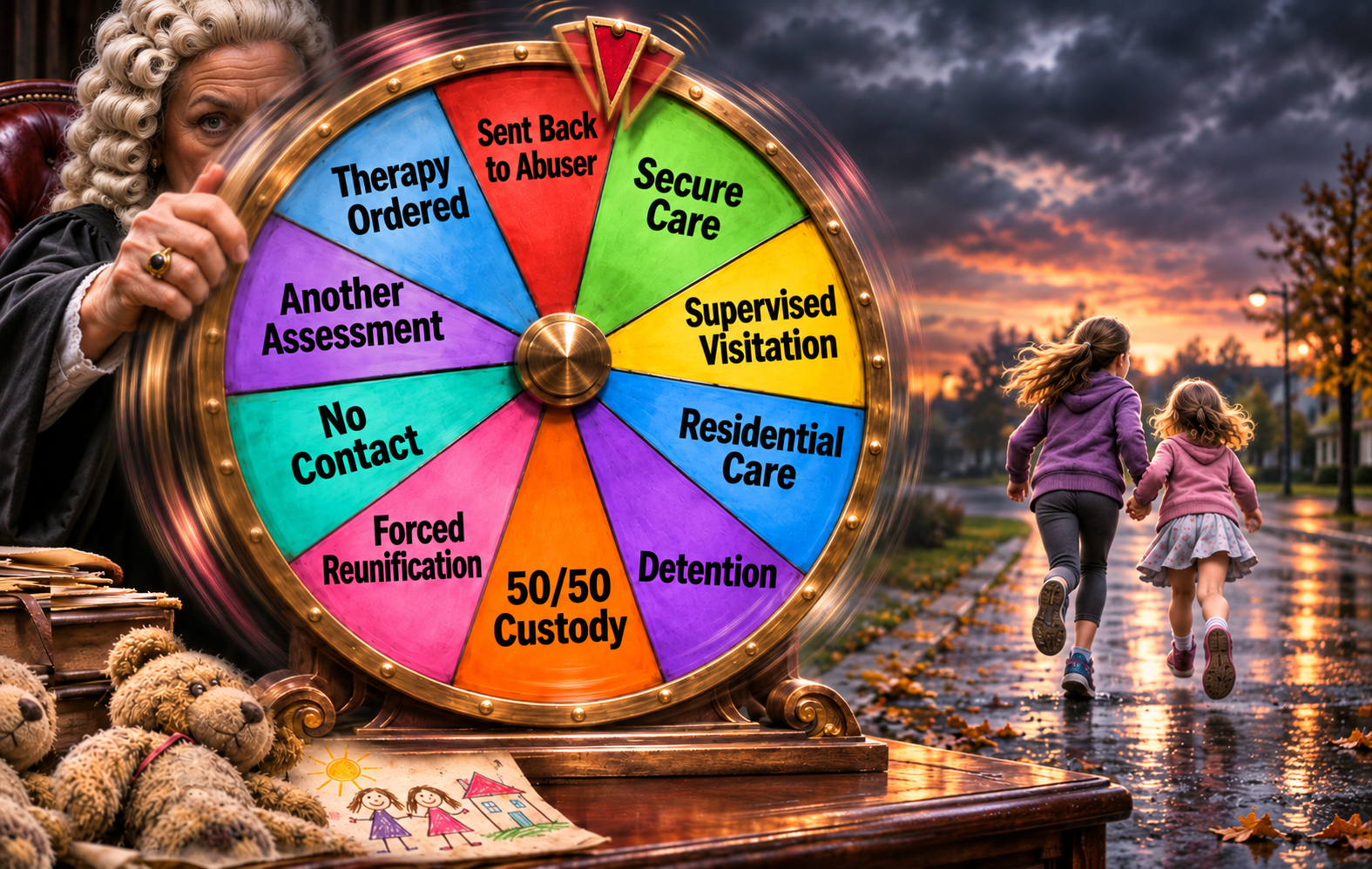
I have encountered families in which children have repeatedly alleged abuse, described their fears to numerous professionals, and desperately resisted being returned to the person they say has harmed them. Yet the legal machinery continues to turn. Sometimes it seems less like a system of justice and more like a grotesque Wheel of Fortune — or perhaps a Wheel of Misfortune.
Roll up, roll up. Another spin, another expert, another hearing. And another child whose life hangs in the balance. So, when children speak, who is listening?
Instead, the question too often appears to become: How do we make this child comply? That happened last year when a child ran for her life — and what did they do? Incarcerate her into Secure Care. It’s a detention facility they call “respite care”. Bloody absurd.
I have also heard accounts of children living in what can only be described as hostage-like circumstances: restricted communication, no phones, locked doors, separation from friends and the constant threat of punishment for resisting. And somehow, this is presented as being in their best interests. Give us a break!!! Come clean.
I fear we have constructed a money-generating system enormously rich in legal procedure but desperately impoverished in social intelligence.
A family dispute enters the system, and an extraordinary industry gears into action – Lawyers, psychologists, psychiatrists, report writers, supervised-contact services and assorted professionals descend upon the conflict. And sometimes it seems the more complicated the dispute becomes; the more people are paid to complicate it further. It resembles a pyramid scheme of professional intervention, except the commodity being traded is not a financial investment. It is the lives of children.
The system has developed its own language, its own procedures, its own hierarchy and, too often, an extraordinary resistance to common sense. Those who challenge its assumptions can find themselves treated not as concerned parents or citizens, but as intruders who have failed to appreciate the wisdom of the professionals.
The question of whether the child is actually safe can disappear beneath mountains of paperwork. Or paper work that has been set aside and shredded.
A Pattern that should Alarm Authorities
THE GUMSHOE SURVEY: In late 2018, after publishing articles about the treatment of children in the family-law system, I became increasingly troubled by the consistency of accounts reaching me.
I conducted a survey through GumshoeNews from 5 November to 16 December 2018, publishing the results on 2 January 2019. I wanted to understand something that seemed almost incomprehensible: why did so many parents report that the more desperately they attempted to protect children who had disclosed abuse — particularly sexual abuse — the more aggressively the legal system appeared to turn against them?
The survey was self-selected and focused on families reporting sexual abuse or serious injury. I made those limitations clear when I published it. Nevertheless, the consistency of the responses was deeply disturbing.
97.1% reported crucial evidence being disregarded.
Of 69 respondents to that question, 67 believed important evidence of abuse or injury had been ignored. Consider that figure. Nearly every parent who answered believed the authorities had failed to take critical evidence seriously.
80.3% reported being accused of coaching their children.
Of 66 respondents, 53 said a court expert or psychiatrist had accused them of influencing their child’s account. The attention shifts from investigating what the child has said to investigating whether the parent made the child say it. How wonderfully convenient.
Of course, parental influence must be considered where the evidence supports it. But influence cannot be a ‘default’. Consider the published statistics. 37.3% of girls aged 16 and over have experienced child sexual abuse. (LINK) The Family Court is in DENIAL.
The survey also raised serious concerns about Independent Children’s Lawyers (ICLs). Of 71 respondents to one question, 47 identified an ICL among those they believed had not believed their child.
In another question, 52 of 67 respondents identified an ICL among those they believed had disregarded evidence of abuse or injury. These were the perceptions of respondents, not findings of professional misconduct. But they raise an uncomfortable question. If the lawyer appointed to represent a child’s best interests fails to convey the child’s fears accurately and fully, who is left to speak for that child?
And the difficulties did not stop there.
80.6% said police had refused to investigate allegations because the matter was before the Family Court. That was 50 of 62 respondents.
77.8% said their own legal representative had warned them against reporting abuse because they risked losing custody. Forty-nine of 63 respondents described that extraordinary dilemma. Report suspected abuse and risk being accused of coaching or alienation. Remain silent and risk failing to protect your child. What!!!
Then came the statistics that troubled me most. 49.2% reported children who were suicidal or had spoken about suicide. That was 32 of 65 respondents.
And 65.6% reported that a court had ordered their children to live with the person they alleged had abused them after evidence of abuse had been presented. 40 of 61 respondents answered yes.
Surely that is reason enough to investigate the pattern. Instead, the wheels of the family-law machinery appear capable of turning almost indefinitely, grinding through families, consuming resources and sometimes leaving children emotionally devastated.
The children are not statistics to be processed. That was January 2019.
Now consider what is unfolding in Victoria, almost eight years later.
Three and a Half Years Later
A VICTORIAN CASE: For approximately three and a half years, a mother has been involved in Family Court proceedings concerning her two daughters. The kids have repeatedly expressed fear of their father and made allegations of serious harm. I have examined numerous reports and documents associated with this matter and followed aspects of the proceedings.
What troubles me is the apparent gulf between the children’s expressed experiences and the direction in which the litigation has proceeded.
The children have reportedly spoken to numerous professionals over several years. Their mother has obtained independent reports, many at her expense. She maintains that important clinical and other material has not been properly consideration in court. Yet another assessment was ordered — this time to be paid for by the father. It is reasonable to ask how many more reports are required before the children’s own voices are given decisive attention.
When I attended court, I was struck by an atmosphere that seemed almost medieval — a court of oyer and terminer, with the mother appearing to be on trial for attempting to protect her children. Whatever she did seemed capable of being interpreted against her. If she raised concerns about abuse, she risked being accused of influencing the children. If she sought to restrict contact, she risked being portrayed as obstructive. If the children refused to attend, their resistance becomes evidence of her alleged influence.
A rather ingenious arrangement.
Initially, the mother cooperated with arrangements under which the father wanted four nights with the children. Their distress and resistance has escalated over the years and finally, she sought supervised contact until the trial date. The children themselves told their father that they did not want to see him again.
His response was to seek primary custody of both daughters, with the mother reduced to professionally paid-supervised contact of a few hours a week. He is slowly bankrupting her – death by a thousand cuts.
Think about how mental this is: Two children have reportedly expressed profound fear and rejection of a parent (including threats of suicide and violence against him). Rather than finding a way to rebuild trust safely, his (and maybe the court’s) proposed solution is – remove them from safe attachment and force them into a hostage-like custody situation. I say “hostage” because they have told professionals that they will run.
What psychological reasoning supports that course? How could such an arrangement be implemented without inflicting further distress?
Those are questions the Court must confront. It becomes intolerable for an average person to watch. It feels like the court has become “possessed” with the ownership – the possession of the children. There are extraordinary consequences of getting such a decision wrong.
The process is simply damaging. Very damaging.
The latest developments raise further questions.
Following a request or application made without notice to the mother, the Court made procedural orders in an ex-parte hearing with the ICL – without the mother. What an extraordinary step. I understand that the mother was also directed to bring a child before the Court. We know where this leads. Return to their father? Secure care? I do know that these possibilities have profoundly different consequences for the children concerned. They must not be treated as interchangeable outcomes on a judicial Wheel of Fortune.
The children no longer trust adults. The voices have not been heard. Have they any representation in this matter?
Under rule 5.11 of the Federal Circuit and Family Court of Australia (Family Law) Rules 2021, applications without notice carry particular requirements, including the need to explain why notice has not been given and to make full and frank disclosure of relevant facts.
Sections 60CA and 60CC of the Family Law Act 1975 require parenting decisions to be directed by the child’s best interests, with attention to safety, the child’s views and their psychological and emotional needs.
They are the legal foundation of the Court’s responsibility.
And if the material presented to a court does not faithfully convey what the children have said, or fails to disclose evidence that materially bears on their safety, that should be treated as an exceptionally serious matter.
An inaccurate professional account can distort the direction of an entire proceeding. One flawed report may influence another. An assumption becomes a finding. That finding is then repeated, relied upon and treated as established history.
I believe any credible evidence of deliberate misrepresentation, serious professional negligence or concealment of material relating to a child’s safety should trigger independent investigation and, where justified, disciplinary action and appropriate child-safety screening scrutiny. People who violate the principals of ‘working with children’ should simply never be allowed to adjudicate over children’s lives. ENOUGH IS ENOUGH.
The law says their best interests are paramount. But a court can close a case, a judge can move on, and the professionals can collect their fees. For the children, the consequences may last a lifetime.
What does a child have to endure before the adults entrusted with protecting them finally wake up?
Sources and notes
Dee McLachlan, “Statistical Evidence: Gumshoe’s Family Court Survey,” GumshoeNews, 2 January 2019. The survey was conducted from 5 November to 16 December 2018 and reflects the reports and beliefs of self-selected respondents.
Family Law Act 1975 (Cth), particularly ss 60CA and 60CC; Federal Circuit and Family Court of Australia (Family Law) Rules 2021, r 5.11.