























by Mary Maxwell, LLB
Fasten your seatbelts. I have some surprises for you.
This article is about one nation being respectful to all other nations. What!
In general, ordinary citizens don’t understand, and don’t try to understand, what goes on among nations. Possibly diplomats know the ropes, but most of us relate to foreign policy, and war only as a News item. We ask “What’s the latest?”
Understandably, there’s a reluctance to believe anything we hear about International affairs, since the ‘source’ of the information is likely biased. Another obstacle is that each nation may express what it’s doing in words that do not correlate with reality – i.e., they lie. Note: Each nation probably has delusions, itself, about what it is doing.
In this article, I will ignore those problems in order to jump quickly to discuss what I see as a normally huge barrier to “international morality.” Yesterday, on Judge Napolitano’s podcast, the host and a guest were discussing America’s rights (and fears) in connection with the ongoing war with Iran. Someone then wrote on the Chat page: “Iran has rights, too.” It looked funny to see that there. How the hell are we ’Murkins supposed to care about Iranians?
For the first part of my career, I researched evolutionary biology, and for the second part I worked in the field of law. I noticed that little in the way of international law has the ring of morality to it, in the way that much of domestic law does. Domestic law is largely about justice; it’s about two adversarial parties, or competing parties, having to bow to the moral notion that something is right or wrong. A judge judges the case, based upon well-accepted principles of law. These are often pure, biological instincts here. They have to do with altruism and reciprocity.
In 1945, the first mega-law for international actions got written as “the United Nations Charter.” Soon enough, in 1948, members of the UN General Assembly made a resolution called The Universal Declaration of Human Rights. It had no teeth but was a definite inspiration around the world. Subsequently it took until 1966, not a great length of time, just 18 years, for treaties or multilateral conventions to be forged out of that Declaration. One expanded into the ICCPR, International Covenant on Civil and Political Rights. Another, not signed by the US, covenanted various “social and economic rights.”
Those treaties don’t directly have teeth, but courts of any member state can make use of them domestically. And now, since 2002, there is an International Criminal Court , the ICC, authorized to deal with certain crimes by governments. It has teeth -– it can convict a person and call for his delivery to the Hague for whatever prison sentence he has received.
These do appear to be developments in international morality – hurrah! But what I wish to discuss here is that, generally speaking, it is psychologically very hard for people to get involved in justice outside of their own nation. People feel embarrassed if they stick up for any nation whom their own nation is busy hurting. And, very predictably, their local friends will turn on them for being “disloyal.” They will say “Come on, get in line, we need to win – you are harming your own people.”
OK. That makes sense (sort of). As theologian Reinhold Niebuhr stated, in his 1932 book Moral Man, Immoral Society, an individual wants to do right –- we have a conscience for that. But a society wants to do wrong. It wants to raid the tribe whose resources look raid-able. It may even find it strategically best to wipe out that whole tribe. “Rah! Rah! We are great. They’re subhuman. Cha-aa aarge!”
(You know I’m not exactly talking about the aggressive society of the Yanomamo in the Amazon forest, as studied by anthropologist Napoleon Chagnon, right?)
When I got down to writing my PhD thesis, which is published as “Morality among Nations,” I had no trouble noticing that we all do this. Your church-going neighbors probably do NOT think we are conscience-free raiders — they might naturally transfer a Christian theme of “love everybody” to international matters. They might even think the US, far from being a raider, is a Good Samaritan 24/7. (No, seriously).
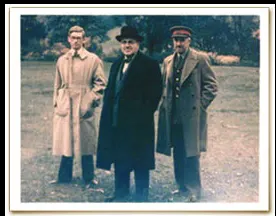
Sir Harry Hinsley
Excuse me but I am in a big hurry today, with nuclear war being threatened. I want to come away from my self-satisfaction of being the oh-so-clever sociobiologist who penetrates the mysteries of human psychology from our jungle days. Today I want to kick this theory (Moral Man, Immoral Society) off my desk. I want to replace it with something a bit more mature, a bit more clever. Let me try a mini-revolution.
This is supported by a letter I discovered a few months ago, among my papers. I was trying to clean house, as I had recently had to clear out my sister’s house after she died. I wanted to keep only the correspondence that would mean something to my survivors. Luckily, up popped a letter I had totally forgotten about, sent to me in 1989 by Sir Harry Hinsley (1918-1998). He is the author of Sovereignty (1986), and had worked at Bletchley Park as a code breaker during the war. I had asked him to advise on my PhD material.
Pretty sure he typed this letter, as we did not have desk computers in those days. So I was grateful to him for providing a lengthy quote, which I’m now pleased to share with you. It is prefaced by:
“Dear Mrs Maxwell … your pages recalled to me, some of the work of Benjamin Kidd, in particular two articles he wrote in 1907-8 in Rivisita di Scienza which struck me when I first saw them. They were the subject of a book on Kidd by DP Crook, C.U.P., 1984 which you would find interesting if you can get a hold of it. A short quotation reads:
“We live in the presence of colossal national armaments. And in a world, therefore, in which we are continually met with the taunt that force is still everywhere omnipotent. It may be perceived, however, that beneath all outward appearances a vast change has been taking place. In the ancient civilizations, the tendency to conquest was an inherent principle in the life of the military state. It is no longer an inherent principle in the modern state. The right of conquest is indeed still acknowledged. In the international law of civilized states.
“But it may be observed to be a right becoming more and more an impracticable and impossible right among the more advanced peoples. Reflection, moreover, reveals the fact that the right of conquest is tending to become impracticable and impossible not, as is often supposed, because of the huge armaments of resistance with which it might be opposed. But because the social consciousness has been so deepened in our civilization that it is almost impossible that one nation should attempt to conquer and subdue another after the manner of the ancient world.” [Emphasis added]
Thus, Kidd in 1907, and Crook in 1984, and Hinsley in 1986, have all GRADUATED us out of evolutionary kindergarten. Thank you, Sirs. We should duly have our picture taken in caps and gowns.
Philip Allott’s “Society of Societies”
That said, we should also look at the work of Philip Allott, Professor of International Law, at the University of Cambridge. I have often quoted the ‘incentivizing’ book he wrote in 2016, entitled Eutopia: New Law and New Philosophy for a Troubled World. Yes, that’s Eutopia written on the 500th anniversary of Sir Thomas More’s Utopia. It is not about history. I’d say it’s about neurology – how can we get those neurons to perk up and face the big empty future.
Allott does not exactly call the future ‘empty.’ Rather, he means “Nothin’ can stop us now.” He repeatedly urges the young to realize that the human world is no more ‘finished’ now than it was at any other point in time. There is no reason for history-making to halt. Why would there be? The same human brains that made all the past discoveries (including philosophical ones) are right there smack in the middle of your cranium.
Today in keeping with my mention of Kidd, Crook, and Hinsley, let’s dwell on a different tome by Allott that came out in 2002. It’s title, which I hope gives you pause, is: The Health of Nations: Society and Law beyond the State. The front page says:
“The human world is changing. Old social structures are being overwhelmed by forces of social transformation which are sweeping across political and cultural frontiers. A social animal is becoming the social species. The animal that lives in packs and herds. (family, corporation, nation, state…) is becoming a member of a human society, which is the Society of all human beings, the Society of all societies.” [Emphasis added]
Frankly, the concept of a society of societies does not exactly trip off my tongue. And in all the blather on Internet about the current war in Iran, we can safely say that “a society of societies” has not tripped off the tongue of any of our leaders. But don’t let that stop you. One’s own society can look after its people’s lives as a whole. So isn’t it reasonable to say that any person in any society can “look up” and see something of a higher, created entity? How’s about correcting Niebuhr’s “immoral society” to “belatedly moral society, living in happy social company with the many other societies”?
Philip Allott served on the Law of the Seas Conference, whose last session ran from 1978 to 1983. Think about it, Young People. One of the established rules of international law is that no nation owns or controls the high seas. This should have prevented the war-adapted use, by Iran, of the closure of the Strait of Hormuz.
I ask you to talk that up with your buddies. Ask what they think we could do about such things. Please go out to the highways and the byways and force them to come in. I’ll be waiting to hear that one of you has prevented any futherance of the horrible destruction in the Middle East. Thanks!
Dear Mary,
AND I HAVE some real news for you to consider that is real?
Real Mary at
http://www.beforeitsnews.com – people powered news,
“WTPN SITUATION UPDATE 723……. “
If they can manage 20 mins after the sad opening.force start.
524
Mart m.
I am up to about 60 mins and wonder whether youvhave a clue.
Same with all the other usuals here?
617
Max Blumenthal: Press Freedom US-Israeli Partnership Threatens US Press Freedom
https://www.youtube.com/watch?v=5j3r3bO6Jh0
This is the way I understand “Section 44” of the Constitution –
The UN Charter signing as a treaty by Australia for example in 1945 left Australians subject to a foreign power and therefore ineligible to sit in parliament under section 44 of the Commonwealth of Australia Constitution Act.
Under section 44 of the Australian Constitution no citizen is eligible to sit in parliament because we are all subjects of a foreign power – Pandemic treaties, the RBA, the United Nations and if “THE VOICE” referendum was affirmed, Aboriginals.
Under section 44 of the Constitution those subject to foreign power are ineligible to sit in parliament.
“Any person who:
is under any acknowledgment of allegiance, obedience, or adherence to a foreign power, or is a subject or a citizen or entitled to the rights or privileges of a subject or a citizen of a foreign power; or
is attainted of treason, or has been convicted and is under sentence, or subject to be sentenced, for any offence punishable under the law of the Commonwealth or of a State by imprisonment for one year or longer; or
is an undischarged bankrupt or insolvent; or
holds any office of profit under the Crown, or any pension payable during the pleasure of the Crown out of any of the revenues of the Commonwealth: or
has any direct or indirect pecuniary interest in any agreement with the Public Service of the Commonwealth otherwise than as a member and in common with the other members of an incorporated company consisting of more than twenty-five persons;
shall be incapable of being chosen or of sitting as a senator or a member of the House of Representatives…………………….”
Come on, you are sounding like MM.
So what.
The bastards do not care about your legalise.
We are dealing with serial world wide criminals and there is only one way to deal with them and their abettors.
I recall the reported comment by Mrs Obama to his wife.
“ALL THIS FOR A FLAG”
627
‘All thus for a flag’!
Caltrop, as you are so researched, you surely remember the video of Madame Obama quietly sipping Champagne on a boat watching Notre dame cathedral burning down.
647
April 2018
Come on caltrop, surely you can help and contribute your research for us, that you claim and put all the dots together and inform all the normies .
💁🤪
227.
Is the Burning of Notre Dame a Mega-Ritual?
https://www.winterwatch.net/2019/04/is-the-burning-of-notre-dame-a-mega-ritual/
………….As the New York Times illustrates;
“Instead, in a miracle of timing, the sculptures of the Twelve Apostles and four New Testament evangelists escaped a fiery end when they were plucked by cranes and removed just days before the blaze in Paris on Monday. It was a small cause for celebration after the destruction of two-thirds of Notre-Dame’s roof and spire. People were also cheered to learn that crosses, a crown of thorns and the famous rose window also survived the flames.
https://www.gnosticwarrior.com/the-masons-of-notre-dame.html
💁keep expanding Clartop🤪
A treaty is just a trick for insiders to open the door for a Trojan. Commies can not survive “equality”, and you think Albo will go open house or will he deploy Australia’s pathetic violence ability. Plenty of fire power at short range, and plenty of hubris for cover, though.
The UN, ICC, all nation states are all commie parasites in lock-step. Sorry US, you never took the republic(Articles of Confederation) that was so close at hand, instead took the Trojan billing machine aka The Constitution.
The end is nigh
COL. Douglas Macgregor : US Abandons Its Gulf Allies
https://www.youtube.com/watch?v=DtjjsZ8X7Wk
Trump readies ‘massive attack’ on Iran as additional 150 medics are sent to a military hospital in Germany that treats US troops wounded in Middle East
News Updates From CLG
CLG News
Jul 23
(Why are 150 medics needed when all US bases have been bombed and only 4 US personel killed?)
Col Douglas Macgregor: New Russian General Signals Major Escalation in Ukraine
https://www.youtube.com/watch?v=2UWWYxRtiYg
Russia will be looking forward to putting an end to the war with Ukraine so as to be properly able to assist Iran.
How America’s Corporate Class Became Legally Unaccountable (w/ Marie Gottschalk) | TCHR
The Chris Hedges YouTube Channel
July 24 2026
Professor Marie Gottschalk explains how Trump’s rise is a consequence of US Empire, militarized police and Capital’s stranglehold on politics.
https://www.youtube.com/watch?v=2ziQ-T7Nu8s
Another forecast.
Ben fulford on 23/7/26 all sad and fun.
about 20 mins.
Heaps of fake gold at F K.
Most fun is in Israel, Netty dead and Graham done by the Russians……..? Trump fake!
Rothschild, – Jews TO BE FREED
http://www.beforeitsnews.com people powered news
1157
https://rumble.com/shorts/v76cumu?e9s=src_v1_eh_cs&utm_source=newsletter&utm_medium=email&utm_campaign=Kim%20Iversen
Christopher Bollyn 2017 SPEECH on 9/11 and the War on Islam
https://www.youtube.com/watch?v=DSMnAtkacSA
Very interesting connections no one talks about.
Donald Trump, Candace Owens & Tucker Carlson – Born On The 4th Of July
Brendon O’Connell
The United States and genuine freedom and sovereignty, hangs by a thin thread of a common circus of half wits, and vested interests, of every kind. I’m sure we will be fine.
Lets understand a few things about Problem, Reaction, Solution.
00:00 Introduction. President Donald Trump addresses the nation on the 4th of July.
02:43 God Bless America for all it’s sins. – – – – – Lets remember the Portuguese, Spanish and Soviet Empires. – – – – – Lets focus on Candace OWENS to make the point. If she is so worried about Israeli subversion, let them expose Israel and 911 and Israeli total control of critical infrastructure. Funny, they say nothing with twenty plus staff on hand – – – – – Candaces “Daddy In Law”, Lord Farmer. Deep in the social network of Lord Jacob Rothschild and King Charles at The Council of Christians and Jews.
09:42 The Candace WOENS Rothschild network. OWENS was Charlie KIRK’s handler and encouraged Charlie and Erika marrying. – – – – Milo YINNOPOLOUS and America moving back to The Crown Corporate.
16:30 General Jim Jones (Dynology), Roger Stone, Clavicular and Peter THIEL. LooksMaxing, steroid use, cocaine trafficking and the Israeli Russian Mafia in Florida.
24:37 Lord FARMER, Lord ROTHSCHILD, King Charles and the Council of Christians and Jews…the rats nest. Charles visits the UK colony, begging for a role ni the Middle East.
30:08 Cenk and The Young Turks, soros money and Shaun RYAN, whose studio looks like a Scottish Rite Masonic gentlemans club. – – – – The new quasi Neo Pagan religion of Joe ROGAN and Ari EMANUEL. Amatai ETZIONI and The Communitarian Movement. The vast network in front of us, building The Smart Cities program.
37:36 Candace OWENS and the Scottish Rite Mason photo. – – – – The Jews of Scotland, from The Court Jews to the Rothschils. – – – – – Roger Stone as Napoleon. Courts as Jewish temples. Blood moon Jochaim and Boaz in Kuala Lumpur Malaysia.
44:13 White woman spreads her legs in Kuala Lumpur City center.
45:28 They run everyone. Jewish Power via the money lenders. The Hufjuden, Court Jews. Why cant people work out Candace Owens?
48:54 Shaun RYAN and Masonry, Russel BRAND, Andrew TATE, Lord FARMER, Noaha HARRARI, Whitney WEBB.
55:16 Gavin WINCE, Millie WEAVER and Shadow Gate. Gavins membership of The French Grand Orient Lodge. – – – – Miracles and Quantum Physics. They want pure, rational, luciferian logic in the age of A.I and computer control.
1.:1:05 Candace OWENS pushed Charlie KIRK to marry Erika. Who is benefitting from the assassination of Charlie Kirk? Of course Candace OWENS and Tucker CARLSON don’t want globalist Iran attacked.
1:07:19 Conclusion and summary.
https://www.youtube.com/watch?v=twknyM6zJ4A
Good post though with Putin I think he would say – keep your friends close and your enemies even closer.
Sandra, so it’s not fun💁😜