


















Just the Maxwell v Trump Exhibits, Please — Orwell, Guyenot, Aaronson, Shulze, Allott
by Mary W Maxwell
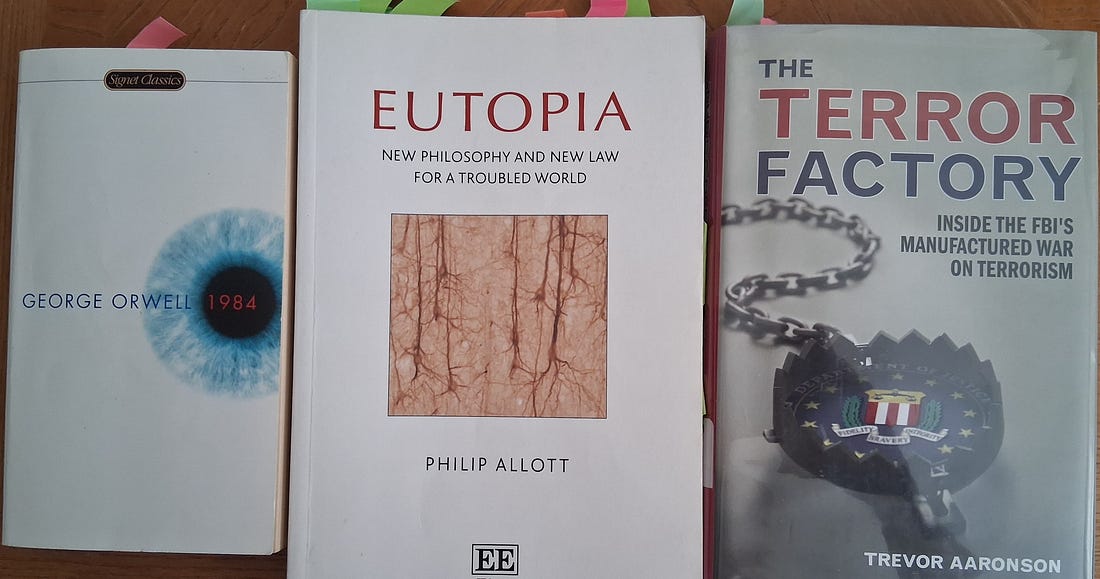
My lawsuit, Maxwell v Trump, is at the Appeals Court in Boston. In addition to its main argument about the unconstitutionality of the Iran war, I brought together the work of five scholars as exhibits. It is imperative that Americans right now become aware of, especially Trevor Aaronson’s book, The Terror Factory, in which he shows that so much of the FBI’s reports of terrorist incidents in America is, pardon me, BS.
But please read all five exhibits. I hope the judges take them into consideration.
Exhibit A. George Orwell on The Real Purpose of War
[Within Orwell’s 1984, is a smaller book written by “Emanuel Goldstein.” It contains this]:
“The essential act of war is destruction, not necessarily of human lives, but of the products of human labour. War is a way of shattering to pieces, or pouring into the stratosphere, or sinking in the depths of the sea, materials which might otherwise be used to make the masses too comfortable, and hence, in the long run, too intelligent…. The primary aim of modern warfare is to [avoid] raising the general standard of living. (in accordance with the principles of doublethink, this aim is simultaneously recognized and not recognized by the directing brains of the Inner Party)…
In the early twentieth century, the vision of a future society unbelievably rich, leisured, orderly, and efficient … was part of the consciousness of nearly every literate person…
It was clear to all thinking people that the need for human drudgery, and therefore to a great extent for human inequality, had disappeared. If the machine were used deliberately for that end, hunger, overwork, dirt, … disease could be eliminated within a few generations. …
But it was also clear that an all-round increase in wealth threatened the destruction – indeed, in some sense was the destruction – of a hierarchical society. In a world in which everyone worked short hours, had enough to eat, lived in a house with a bathroom and a refrigerator, and possessed a motor-car or even an aeroplane, the most obvious and perhaps the most important form of inequality would already have disappeared.
If it once became general, wealth would confer no distinction. It was possible, no doubt, to imagine a society in which wealth, in the sense of personal possessions and luxuries, should be evenly distributed, while power remained in the hands of a small privileged caste. The problem was how to keep the wheels of industry turning without increasing the real wealth of the world. Goods must be produced, but they must not be distributed. And in practice the only way of achieving this was by continuous warfare.
Exhibit B. Laurent Guyénot on How Iran War Started
(From Guyénot’s May 19, 2026 article “Deep Trump” at radbodslament.substack.com)
Consider how the decision to bomb Iran was made last February, as explained by the New York Times in an April 7 article…. On February 11, a meeting was held in the White House Situation Room attended by Benjamin Netanyahu, accompanied by Israeli intelligence officers.
Standing before a screen showing Mossad Director David Barnea and Israeli military officials, Netanyahu presented his case for bombing Iran with the aid of a PowerPoint presentation, demonstrating that it would bring down the Iranian regime and thus resolve instantly all the problems in the Middle East in one fell swoop, while making Trump the greatest man in history.
Seated across from him were President Trump, Secretary of War Peter Hegseth, Chief of Staff Dan Caine, Secretary of State Marco Rubio, CIA Director John Ratcliff, Chief of Staff Susie Wiles, as well as Jared Kushner and Steve Witkoff, unofficial negotiators. After Netanyahu’s presentation, Trump nodded and said, “It sounds good to me.”
The same group met again the next day, without Netanyahu but with Vice President JD Vance, … A final meeting took place on February 26, including a few other people, such as advisor David Warrington, who discussed the legality of such an intervention. Trump concluded the meeting with these words: “I think we need to do it.”
In the meantime, Vance had had several phone conversations with Netanyahu, who was urging him to act quickly. The next day, February 27, Trump sent the following message from Air Force One: “Operation Epic Fury is approved. No aborts. Good luck.”
Exhibit C. Trevor Aaronson on FBI as Terrorism’s Agent Provocateur
(from Aaronson’s 2013 book “Manufactured Terrorism,” lightly edited)
After 9/11, the FBI was tasked with recruiting a great number of informants who could check on the lives of Muslims. As a private researcher I became interested in “Muslim terrorism.” My statistics show that in the ten years following 9/11, the FBI and Department of Justice indicted and convicted more that 150 people via sting operations. If these, the FBI not only led 50 of the terrorist plots but also provided all the necessary weapons, money, and transportation.
The justification? By catching a lone wolf before he strikes, federal law enforcement can take hi off the streets before he meets a real terrorist who can provide him with weapons. However, to this day, no example exists of a lone wolf who, unable by himself to launch an attack, met a terrorist and became operational. Granted, an Afghan-American named Najibullah Zazi, came close to attacking the NY subway in 2009, with a plan to place backpack bombs on crowded trains but he had international connections and the ability to carry out the work on his own.
When Obama became president in 2009 he used many sting operations. In three years, his DoJ prosecuted 75 terrorism sting targets. Obama embraced national security as a tenet of his office. He also engaged US military resources in the ouster of Libya’s Gaddafi, and conducted secret wars in Yemen and Somalia. The FBI has become effective in creating the enemy it is hitting.
If the Fort Dix Five, as the media later dubbed them, were terrorists, they were coerced ones – pushed along by criminals who had personal interests in their prosecution. (I know of a case where the informant got $100,00.) Dritan Duka said that in the aftermath of 9/11, Muslims could be arrested just for talking. Bakalli asked the Duka cousins wat jihad meant. It didn’t mean violence, they told him, it was a personal struggle against oneself and a struggle to lead a good life. Soon, the FBI arrested the 5 men and charged them with attempted murder and conspiracy.
The key to conviction was that the prosecution did not have to prove that the Fort Dix Five would do the murder, just that they talked about it. This is the crime of conspiracy. In closing, US Attorney Fitzpatrick told the jury “We don’t have to prove that they intended to kill.”
This goes against the landmark case Brandenburg v Ohio (1969). Clarence Brandenburg, a Ku Klux Klansman, had given an inflammatory speech in 1964. He was prosecuted under an Ohio law of 1919 that prohibited advocating “unlawful methods of terrorism.” He appealed his conviction to the US Supreme Court where it was overturned – as the government cannot punish speech unless it is intended and likely to result in imminent lawless action.
Mehenna’s case is connected to this. Actually, the way prosecutors got around Brandenburg was by saying that Mehanna’s advocacy of Al Qaeda and violence provided ‘material support” to the terrorist organization which is against one of the new laws.
At his sentencing in 2012, Mehanna addressed US District Judge George A O’Toole, saying that he was the victim of a vengeful prosecution for his refusal to be an FBI informant. “I have spent the majority of four years in a solitary cell, the size of a closet, locked down for 23 hours each day.” Judge O’Toole, unmoved by Mehanna’s statement, sentenced the 29-year-old to seventeen years in prison.
Exhibit D. Terry Shulze on Magna Charta and the Rational Basis Test
(From “Review of Australian Law and Its Decline,” by retired barrister Terry Shulze, at GumshoeNews.com June 19, 2018, lightly edited)
A farmer asked my help as he suffered financially from an Egg Industry Act by New South Wales Parliament. I thus inquired if the law had a rational basis. In the US,an enactment may be invalid if it does not serve a purpose. This is traceable to Heydon’s Case of 1584 in England which searched for “the mischief which the statute was designed to remedy,” i.e., its raison d’etre.
The 1787 case of Bowman v Middleton, was about a 1712 Act of the Assembly which transferred a freehold from to another, without trial or compensation. The Court at page 254.8-held “that the plaintiffs could claim no title under the Act in question, as it was against common right, as well as Magna Charta, to take away the freehold of one man and vest it in another… without compensation, or even a trial by the jury…. That the Act was, therefore, ipso facto, void. That no length of time could give it validity, being originally founded on erroneous principles.”
This ‘rational basis test’ isn’t known by this name in Australia. However, in NSW, the validity of a law can be checked by its accordance with the Colonial Laws Validity Act. I gathered up some early cases, such as MacDonald v Levy (1833). Judge Burton recognized the duty of the judges as the guardians of the rights of the people. At page 49.0 he states,
“I look upon this clause as the great charter of the Colony, and at once yielding to the colonialists all that by the common law, or the liberal, and enlightened, and accumulated wisdom of our ancestors, has been provided for the protection of life, liberty and property, and for regulating the transactions of men with each other. All becomes by virtue of it “the justice and right” which the justices are sworn to do to all the King’s subjects, and is expressly provided in one of the clauses of Magna Charta.”
I (Shulze) found that Judge Wise, in Rusden v Weeks (1861) clearly supports the position of judicial review of legislation of the NSW Parliament:
“…as the supremacy of the law is the characteristic of every constitutional government, it becomes imperative duty of courts of justice, independently of all political considerations, to decide which is the law of the land.”
In general, the early judges (prior to Australia’s 1901 Federation) clearly considered that the people of NSW had fundamental constitutional rights,
that the courts could declare an Act of Parliament void, that the laws of the legislature must be reasonable and not inconsistent with the Constitution and that the fundamental documents, such as the Magna Charta, Bill of Rights and Habeas Corpus Act comprised parts of the Constitution.
However, two things occurred in the latter half of the 19th century in NSW which perverted this thinking. One was a book “The Constitution of the Australian States” by RD Lumb, which said. “No colonial law was to be void on the ground that it was repugnant to the fundamental principles of English Law.”
The other was the reassertion of legal positivism in the form of “Parliamentary sovereignty.” South Australia’s Parliament had written to Queen Victoria, in 1864, bemoaning: “the danger and impolicy of leaving in the hands of the Colonial Judges the power to declare the Acts of this Parliament illegal… We, therefore, trust that Your Majesty will graciously relieve us from further suffering under this enormous evil… that it shall not be competent for any Judge in the Courts of Providence.
(The judges’ reply was “No.”)
I noted works of Sir Edward Coke (1552-1634). He had said, in Dr Bonham’s case “when an Act of Parliament is against common right and reason, or repugnant, … the common law will control it, and adjudge such Act to be void”.
Coke also said, during the drafting of the Petition of Right of 1627, that “sovereign power is no parliamentary word. … Magna Charta is such a fellow that he will have no sovereign.”
Did I win my challenge to the Egg Industry Act? Some say I did, insofar as a back channel to the NSW Parliament alerted someone to my plans and so they got rid of the Act. What’s more, they legislatively offered compensation. The small farmers in the industry couldn’t believe what happened – they were receiving money instead of being harassed. My client received 1.2 million dollars, of which I never saw a penny. (But earlier I was given a frozen turkey and 4 dozen eggs.)
Personally, I think the situation has further declined since 1985. I know not the reason why each judge takes their path regarding the independence of the judiciary, but it does appear from reading the various cases that, if the judiciary has lost its independence, it is a ‘self-inflicted wound’.
Exhibit E. Eutopia: New Philosophy and New Law for a Troubled World
by Cambridge University Professor Philip Allott, 2016
Note: Allott was for 13 years a legal advisor to UK Foreign office, an experience that inspired him to offer a new philosophy for International Law. See his Eutopia. The abstract of Allott’s 2002 book “The Health of Nations: Society and Law Beyond the State” says:
The human world is changing. Old social structures are being overwhelmed by forces of social transformation which are sweeping across political and cultural frontiers. A social animal is becoming the social species. The animal that lives in packs and herds (family, corporation, nation, state) is becoming a member of a human society which is the society of all human beings, the society of all societies.
The age-old problems of social life — religious, philosophical, moral, political, legal, economic — must now be addressed at the level of the whole species, and the level where all cultures and traditions meet and will contribute to an exhilarating and hazardous new form of human self-evolving….There will be new levels of human energy, creativity, intelligence, to serve the highest aspirations and the highest ideals of all humanity. We know that we will be writing a new page in the better story of human self-evolving.
— My full appeals brief is at www.ConstitutionAndTruth/Court
Mm, your last paragraph
You are dreaming.
How do you plan to address those matters?
Even you and a few others cannot address a basic reality.
The fake inauguration of a fake Biden that you cannot face. Perhaps you have no clue after four years. Have you addressed the obvious in your campaign? Have you tried to tell your prospective voters anything of real history and supporting evidence.—- who did 911🤷♂️😜
So give us a break with your idealistic dreams and murmuring.
Tell us what dreams you might imagine, that were not attempted to be achieved without a musket.
Tell us who did the Boston bombing!
Deign to tell those whose votes you seek who should not be hanged for treason!
Your campaign appears to be grounded in BS if you cannot face basic evidence. You present as a lawyer. BS!. Why are you presenting as special! When you seem to be unable to present the available evidence to your jury of piers.
957
The last paragraph was not written by me. None of these exhibits were written by me.
Re who did the Boston bombing, I filed a RICO suit against the FBI , the Director of the Bureau of Prisons, the Boston Globe, etc for that.
I guess there is reasonable evidence for a fake Biden but not nearly enough for me to proclaim it. Fakery abounds. The entire Sandy Hook affair was fake.
If you want a free PDF of my book on Sandy, just go to the top of this page of Gumshoe and hit “Books.” Or forget that and hit “Awaken Books” written for children by the famous South African rock climber.
Again on the Boston bombing.
Again and again I refered you to the 5 culprits dressed all with tan trousers and black tops as shown at Mike Rivero’s report:
“ALL THE EVIDENCE YOU NEED” ( or similar headline)
The photographs show one of a ‘team/operatives’ (my conclusion) of operatives. One with the back pack that matched the exploded one.
They are pictured running away WITH NO BACK PACK.
Mary, how could you miss ALL THAT EVIDENCE BY NOT INCLUDING ALL THE PHOTOGRAPHS AVAILABLE at:
http://www.whatreallyhappened.com – stories.
Your article missing the significant photos is surely suspicious.
Why?
Could it be suggested that foreign interests, as often, are involved, were responsible?
911 is coming up, I suggest readers search the current headlines at what really happened and use you brain and examine the evidence of a foreign organisation murdering thousands and CELEBRATING as often occurs in ‘deceptions’ to fight war/s
1007
BTW: WHO DO YOU THINK DID 911 AND/ OR WAS PART OF THE REAL MURDER CONSPIRACY.
1013
“I guess there is reasonable evidence for a fake Biden but not nearly enough for me to proclaim it. Fakery abounds. The entire Sandy Hook affair was fake.”
No less of an authority than Alexa claims Biden is dead :
https://poal.co/s/Odd/569454
Because there is a plausible answer to why the fake Biden, i.e there was a threat, which is undeniable because them all being a rubber stamp for lawless theft and depravity. Hell even the auto-sign executive order machine probably wanted Biden dead
Trump in a room after a PPP saying “sounds good” etc, is bs, Trump is a muppet just like the last and next “showman”. The plan comes before the “war-room” theater
Which apparent ‘Trump’ are you referring to? 927
sideshow Donald Q Trump, Sorry Iran, this is how it goes, but we all get the haircut
https://www.youtube.com/shorts/XT6Y0D-u0mA
https://beforeitsnews.com/strange/2022/03/no-forgery-the-protocols-of-zion-are-coming-true-2479485.html
very relevant Sandra’s post previous article- The West Report
https://www.youtube.com/watch?v=mKu9EEVdJao&t=741s
“The person who controls the Infrastructure controls the body inside it”
Trending today my “brain to computer interface” reporter
Worldwide Medical Military Martial Law Plan Exposed!
Aug 26 2022 note Tony Ryan And Dee contribution and Ned’s thread
https://gumshoenews.com/worldwide-medical-military-martial-law-plan-exposed/
Now lets Acknowledge Mary W Maxwell’s article above — as always brilliant work–really read the article
Then Stop Press– from Mary’s Substack today
https://maxwellm.substack.com/p/getting-our-happiness-back?r=266zdu&utm_medium=ios&triedRedirect=true
Read the article and FIND MARY
NB Mary Turquoise Jumper 47 minutes
Extraordinary reporting Adelaide Mysteries, Part 1: Rachel Vaughan Interprets “Zombie Apocalypse” – Gumshoe News
https://gumshoenews.com/adelaide-mysteries-part-1-rachel-vaughn-interprets-zombie-apocalypse/
For Mary me and Bobby McGee
https://youtu.be/941PHEJHCwU?si=6AffCKj98puw-3OBG
Thanks for being part of my world Mary— never ever give up
“Exhibit A. George Orwell on The Real Purpose of War
[Within Orwell’s 1984, is a smaller book written by “Emanuel Goldstein.” It contains this]:
“The essential act of war is destruction, not necessarily of human lives, but of the products of human labour….”
Capitol built upon Lot 666
Author: Ahatmose ()
Date: March 29, 2004 05:26PM
And how does Washington DC fit into all of this ?
From this page: What on earth is going on at Denver International Airport ?
[www.geocities.com]
… Today the city of Washington, District of Columbia, is a veritable mirror of illuministic endeavour, a city-temple meticulously constructed according to the religious rites of freemasonry. Incorporated into its street design can be seen the Sphinx, the thirteen tiered pyramid with the All Seeing Eye of Horus staring down an avenue into the White House. The US Capitol, built upon Lot 666, is shaped into the Goat of Baphomet and sits atop a truncated pyramid. The Washington Monument symbolises the venerated male organ of Osiris. According to legend, the ancient antichrist emperor, Nimrod (later deified as Osiris), was hunted down shortly after the Flood by one of Noah’s sons, Shem, and brought to trial for crimes and abominations committed against YAHWEH. Nimrod was tried by an assize of 49 judges in Egypt and sentenced to death by dismemberment, his 13 body parts carried into the various corners of the known world and displayed as an example to the world of the consequences of blasphemy and apostasy against the Invisible Mighty One of Israel. Nimrod’s wife, the beautiful witch Semiramis, resolved to seek out the pieces of her husband’s body and found all but the penis, which later became a symbol of veneration and worship by the pagans as the bringer of life and the ultimate generative principle. Thus phallic worship became a staple of ancient Egyptian religious culture, Nimrod became deified as Osiris (Ammon-Ra), his wife Semiramis as Isis, the Earth mother goddess. The Jewish (? Judah not yet born) leader, Shem, became the wicked god, Seth, forever plaguing the peoples of the Earth with restrictive covenants and binding moralities (Levitican Law).
I haven’t verifed any of this yet [ I plan to] but it sure makes for interesting reading.
Don Barone
https://grahamhancock.com/phorum/read.php?2,447703,447705
The Statue of ‘Persephone’ on Capitol Hill –
“Columbia” is a name for “Goddess of Creation, War, and Destruction” better known as the goddess of death and pain. She is derived from the imagery of Semiramis, wife of Nimrod, and Queen of Babylon. –
The statue on top of the Capitol building called the Statue of Freedom is actually Persephone, meaning “She who Destroys the Light”. She is the queen of the underworld. She is crowned with pentacles (pentagrams–stars with five points). When someone stands on something, it is usually an indication of ownership. Therefore, she owns the facility she stands upon. Although the dome on top of the Capitol building was not finished until 1868, the final installation of this statue on top of the dome took place on December 2, 1863. The original Capitol building, without the dome, was completed in 1826.
https://esotericcolumbia.blogspot.com/2018/10/columbia-sc-isnt-named-after-columbus.html
Billionaires are Behind Communism – Reece Committee
Most of America’s great fortunes were made by men chosen by the Rothschilds and given the money
to become monopolies. Naturally, they share the Rothschild goal of worldwide Communism, which is essentially a monopoly over everything- money, power, belief & thought. Thus they must destroy all collective forces – race, religion (God), nation and family (gender.)
As this article indicates, they used tax-exempt foundations to re-engineer America in the direction of Communism. Their mandate was “to alter life in the United States that we can be comfortably merged with the Soviet Union.” This is the origin of endless war, globalism, miscegenation, feminism, “gay rights,” gun control, political correctness, multiculturalism etc. Communism is pretty much a fait accompli in the West.
https://www.henrymakow.com/2018/05/Reece-Committee-Exposed-Billionaires.html
“To learn who rules over you simply look to those you cannot criticize.”
— Voltaire
(10) Why China is now more popular worldwide than the USA – YouTube
https://www.youtube.com/watch?v=uYgRMgKtup0
The Communist Manifesto that was read on the House Floor
THE 45 COMMUNIST GOALS AS READ INTO THE CONGRESSIONAL RECORD, 1963
Congressional Record–Appendix, pp. A34-A35
January 10, 1963
Current Communist Goals EXTENSION OF REMARKS OF HON. A. S. HERLONG, JR. OF FLORIDAIN THE HOUSE OF REPRESENTATIVES
Thursday, January 10, 1963
Mr. HERLONG. Mr. Speaker, Mrs. Patricia Nordman of De Land, Fla., is an ardent and articulate opponent of communism, and until recently published the De Land Courier, which she dedicated to the purpose of alerting the public to the dangers of communism in America.
At Mrs. Nordman’s request, I include in the RECORD, under unanimous consent, the following “Current Communist Goals,” which she identifies as an excerpt from “The Naked Communist,” by Cleon Skousen:
[From “The Naked Communist,” by Cleon Skousen]
CURRENT COMMUNIST GOALS
10. Allow all Soviet satellites individual representation in the U.N.
11. Promote the U.N. as the only hope for mankind. If its charter is rewritten, demand that it be set up as a one-world government with its own independent armed forces. (Some Communist leaders believe the world can be taken over as easily by the U.N. as by Moscow. Sometimes these two centers compete with each other as they are now doing in the Congo.)
12. Resist any attempt to outlaw the Communist Party.
13. Do away with all loyalty oaths.
https://cdn.subsplash.com/documents/W8FD27/_source/5b8c9068-5344-4a33-b77a-31d54f98a52e/document.pdf
The flailing American beast striking out in it’s death throes
Iranian weddings are prime targets following the same playbook as the Israelis
Iran ATTACKS USS George Washington in Historic FIRST, Trump to NUKE Pickaxe?!
Danny Haiphong
Sept 7
Danny Haiphong breaks down Iran’s major strike on USS George Washington, and why forcing its retreat has set a precedent in warfare unseen in history plus much more in breaking news updates
https://www.youtube.com/watch?v=NXgRWOouNQk
“Exhibit D. Terry Shulze on Magna Charta and the Rational Basis Test
(From “Review of Australian Law and Its Decline,” by retired barrister Terry Shulze, at GumshoeNews.com June 19, 2018, lightly edited)…:
On 24th August 1215 the Pope declared the Magna Carta null and void.
“…………Magna Carta – An Immediate Success…?
No. Not in the slightest.
Yes, King John agreed to the terms of Magna Carta, and yes, the barons renewed their oaths of allegiance to him. But the settlement did not last long. The security clause and the 25 barons of Magna Carta made it difficult for King John to wriggle out of the agreement as freely as he would have liked (for he had now given the royal seal of approval to a document that made him as susceptible to the law as any other ‘free man’), and he was much aggrieved by the manner in which Magna Carta had been enforced. And so he sought help from the Pope
Pope Innocent III
At the time, the pope was the official overlord of the kingdoms of England and Ireland. King John sent messengers to the Pope requesting that Magna Carta be annulled. In response, the barons did not give up the city of London, and vowed not to do so until the terms of the charter were implemented.
Pope Innocent III saw the Magna Carta from the king’s perspective, however, and was indeed very alarmed by the charter’s terms. On 24th August 1215 the pope issued the papal bull, a document in which he describes Magna Carta as “illegal, unjust, harmful to royal rights and shameful to the English people”. The papal bull declared Magna Carta “null and void of all validity for ever”………………..”
http://www.magnacartatranslation.com/about-us/magna-carta/
By the terms of the “FOREVER” Treaty of 1213, the Vatican has since owned the Crown which it has rented to the British Monarchy per the terms of said Treaty, to wit:
http://amazingdiscoveries.tv/media/123/211-the-secret-behind-secret-societies/
Perhaps the point that is most important to consider is that the Barons stuck a sword up King John’s nose and said “here, sign this goatskin”.
That is the way tyranny always ends, with force.
PROTOCOLS OF THE MEETINGS OF THE LEARNED ELDERS OF ZION
PROTOCOL No. 1: THE BASIC DOCTRINE
RIGHT IS MIGHT
12. Our right lies in force. The word “right” is an abstract thought and proved by nothing. The word means no more than: Give me what I want in order that thereby I may have a proof that I am stronger than you.
13. Where does right begin? Where does it end?
http://www.whale.to/b/protocols.html#PROTOCOL_No._3_
The Catholic Fourth Lateran Council (In 1215) Proposed Eerie Ideas That Would Be Revived Around WWII
By thehistorianshut -July 18, 2017
https://thehistorianshut.com/2017/07/18/the-catholic-fourth-lateran-council-in-1215-proposed-eerie-ideas-that-would-be-revived-around-wwii/
In 1215, Pope Innocent II (r. 1198-1216) called into session the Fourth Lateran Council. The council was made up of around 400 bishops, 800 other priests of high rank, and a large contingent of representatives on behalf of the monarchs of Christendom. The Fourth Lateran is lauded as one of the greatest church councils preceding the Council of Trent (1545-1563). The members of Pope Innocent II’s council debated reforming church theology, tithes and church lands. They also confirmed the idea of transubstantiation in the Eucharist, the Christian religious meal—transubstantiation argues that the bread and wine taken in the Eucharist transforms into the essence of Jesus’ blood and body. While the Fourth Lateran Council clarified and reformed the Catholic Church in many positive ways, it was in no way perfect. The council’s decisions concerning the treatment of Jews were especially awkward……………….”
From the book
The Two Babylons or The Papal Worship Proved to be the Worship of Nimrod
and His Wife
By the Late Rev. Alexander Hislop
First published as a pamphlet in 1853–greatly expanded in 1858
Hence, the priests of Nimrod or Baal were necessarily required to eat of the human sacrifices; and thus it has come to pass that “Cahna-Bal,” * the “Priest of Baal,” is the established word in our own tongue for a devourer of human flesh. ** * The word Cahna is the emphatic form of Cahn. Cahn is “a priest,” Cahna is “the priest.” **
Covert human extermination: Trump’s partnership with AI giants
Mike Adams My analysis today looks more closely at how Trump is partnering with Big Pharma and Big Tech in an effort to covertly eliminate a large number of Americans. This is probably being justified as a way to keep the government financially solvent and to redirect key resources (such as electricity) to data centers and the race to AI superintelligence.
I’ve got full details today, plus an interview where I appeared as a guest on the Stew Peters show.
Mike Adams interviewed by Stew Peters: Charlie Kirk narratives, Israel, genocide and Trump
https://www.brighteon.com/2c062d71-5e65-401d-820c-5e6571308b60
On Trumps baseball hat you will see “45 – 47” which translates to 911.
911 Mass Kabbalistic Ritual Human Sacrifice | Ancient Forums
911 in the Kabbalah means the birth of the Messiah and relates to greater Israel in the Torah.
“……………The reason the Jews used 9 and 11 as the talisman to transfer the power through is 9 represents destructive creation and bringing things into creation its the power of three to itself and this number CONNECTS what is done three times is considered permanent in the world in Kabbalah and 9 is the total expression of this. This represents the Yesod aspect and dimension of their thought form they channelled this energy into and through this is putting the energy into power and manifestation in the material world. The 11 is the letter of wrath the 11 curses of the Rabbinical leaders on the enemies of Israel in the Torah and the wrath of their “god” in general it also represents Daath which is considers the judgement of “god” in Kabbalah it means death. This relates to “gods” wrath against Amalek in the Torah as well the enemies of Israel. 11 represents destroying the Goyim the nations and bringing in the divine order of ten. The Jewish Messianic world this is why 11 is not counted on the world tree of Kabbalah only the ten.
911 in the Kabbalah means the birth of the Messiah and relates to greater Israel in the Torah. The Messiah relates to the Messianic war in the Middle East in which all the Gentile nations are destroyed and the third Temple is rebuilt in Jerusalem and greater Israel is built.
The purpose of the ritual of 911 was to bring about events in which the enemies of Israel in the Middle East the Arab nations and Iran would be destroyed in the plans of creating Greater Israel. And after this event what has happened? Iraq has been destroyed so has Afghanistan, Libya and Syria and Iran is under the gun for the next war in the Middle East which could happen any day. Millions have died and trillions of dollars have been spent on these wars all making the Jews more powerful then ever and enriching their Federal Reserve dynasties and they looted Iraq with their Jewish run companies like BP for themselves. The wars themselves also become mass acts of ritual human sacrifice for the masters of the Jews out there the Reptilians to use for their own purposes as well as the Jews down here. The amount of suffering, terror, pain, fear and death energy these wars make then transfers through the astral grid of the planet and the mass mind of humanity and then is connected into the rituals of the enemy constantly.
This is how Jewish Witchcraft really works and manifests in the world. The RTR’s are the only way to undo this and stop such from occurring again.”
https://ancient-forums.com/threads/911-mass-kabbalistic-ritual-human-sacrifice.23582/
mmm 4 comments have been disappeared
maybe we can reappear them
Ahh thank you CAL – you did the trick
7 long posts latter— there they are tucked away. buried under the verbiage
great you picked up “Review of Australian Law and Its Decline,” by retired barrister Terry Shulze, at GumshoeNews.com June 19, 2018, lightly edited)– spot on topic.
so I repost
Now lets Acknowledge Mary W Maxwell’s article above — as always brilliant work–really read the article
Then Stop Press– from Mary’s Substack today
https://maxwellm.substack.com/p/getting-our-happiness-back?r=266zdu&utm_medium=ios&triedRedirect=true
Read the article and FIND MARY
NB Mary Turquoise Jumper 47 minutes
and
Extraordinary reporting Adelaide Mysteries, Part 1: Rachel Vaughan Interprets “Zombie Apocalypse” – Gumshoe News
https://gumshoenews.com/adelaide-mysteries-part-1-rachel-vaughn-interprets-zombie-apocalypse/
For Mary me and Bobby McGee
https://youtu.be/941PHEJHCwU?si=6AffCKj98puw-3OBG
Thanks for being part of my world Mary— never ever give up–
I add also for Dolly Parton and thousands who knew their song well before they start singing.
travelling with you –Simon still on the road its the destination that eludes me
Henry D. Abraham: Psychiatrist: “The President is a Danger to Global Survival
https://www.youtube.com/watch?v=WPkkYN3rLtY
“All Hell Will Break Lose…” – Alex Krainer-10:13
Prepare but don’t panic.
Have some tradable items.
History repeating
Alex Krainer discusses how to prepare for a potential economic and financial crisis without panic. He explores debt saturation, banking risks, de-banking, geopolitical instability, and why having emergency reserves and alternative assets could matter.
Krainer also explains his broader view of the global debt system and why he believes a major financial reset could reshape the future.
https://www.youtube.com/watch?v=zvGRxDRTKPg
“Most People Have No Idea What’s Coming…” – Alex Krainer-9:48
Alex Krainer delivers a provocative analysis of the Russia–Ukraine conflict and the broader struggle between competing geopolitical and financial systems. He examines debt, Western financial power, NATO expansion, the Minsk agreements, Iran, and the growing Russia–China–Iran partnership.
Krainer argues that the current global system is approaching a historic turning point—and that a fundamental transformation of the international financial and geopolitical order may be unavoidable.
https://www.youtube.com/watch?v=fswXOEndJxs
China’s Lesson From the U.S.: Finance Must Serve, Not Rule
A nation’s rise begins in factories but can end on Wall Street. Over the past 500 years, four great powers followed a similar path. Is this a warning China can avoid?
September 2, 2026
https://thechinaacademy.org/chinas-lesson-from-the-u-s-finance-must-serve-not-rule/
As in Communism –
Proverbs 22:7
King James Version
7 The rich rule over the poor, and the borrower is servant to the lender.
Australia’s Media in FREEFALL? Antic & Roberts Sound the Alarm
Senators Alex Antic and Malcolm Roberts take aim at Australia’s mainstream media, arguing that legacy outlets have lost public trust and shifted away from traditional news reporting towards partisan commentary and what they describe as a “woke” agenda. Antic questions the future of the traditional media gatekeeper, pointing to changing news consumption among younger Australians and the industry’s reliance on government support, while Roberts highlights falling television audiences, declining media company values and what he describes as widespread bias in mainstream reporting. The senators also criticise coverage of politics, government spending and the COVID-19 response, arguing that Australians are increasingly turning to independent platforms and alternative sources for news.
https://www.youtube.com/watch?v=6HxC6mEUxHo
And the advertisers financing the fake mass media are too dumb to realise that they are wasting their money.
527
7/9/26 situation update at BIN.
Sorry Sandra, but I cannot comment, I have been closed down after a reply to the next article, so I am sneaking in here THIS IS SO SERIOUS FOR OUR INJECTED RElATIVES.
Most of us know of the attempted genocide…… if they are awake.
It is worse, from about 35 mins so far as you can keep a open mind to the end with real Mary:
Now we are getting THE EVIDENCE of pure evil.
http://www.beforeitsnews.com people powered news of misery, death but some hope.
957
Sandra,
My comment that has been suppressed was a reply to the loss of confidence in the media. It has not turned up.
My comment basically was that the advertisers financing fake media must wake up.
I might add that one wonders who the advertisers are, as they may be running a laundromat for support and lies……
1107
JD VANCE’S DENIAL: ‘WE’RE NOT AT WAR WITH IRAN’ -short
https://www.youtube.com/shorts/bXYO8sAay5Y
🟠 JD VANCE’S DENIAL: ‘WE’RE NOT AT WAR WITH IRAN’ (PART 2)
https://www.youtube.com/shorts/rtyYA1sucfQ
These paras resonate with me right now
“Did I win my challenge to the Egg Industry Act? Some say I did, insofar as a back channel to the NSW Parliament alerted someone to my plans and so they got rid of the Act. What’s more, they legislatively offered compensation. The small farmers in the industry couldn’t believe what happened – they were receiving money instead of being harassed. My client received 1.2 million dollars, of which I never saw a penny. (But earlier I was given a frozen turkey and 4 dozen eggs.)
Personally, I think the situation has further declined since 1985. I know not the reason why each judge takes their path regarding the independence of the judiciary, but it does appear from reading the various cases that, if the judiciary has lost its independence, it is a ‘self-inflicted wound’.”
and Mary I know someone who might need your knowledge and your skills the case is Eldridge V Lloyds of London
yes Ned having same problems re missing messages
was going to give up on Gum Gum -but Bob to the rescuehttps://www.facebook.com/reel/1050469074516429
https://www.facebook.com/reel/1626799239061899
As readers are aware, I scan
http://www.whatreallyhappened.com EVERY DAY.
It is a distressing exercise, but necessary to realise that the AbC, MSM and its shock jokes are either liars and frauds or basically hypocrites and stupid.
Just go to WRH AT THE TIMELINE
07.08.17 today for about 30 seconds to hear a link from X.
SICK SICK SICK SICK SICK SICK SICK.
🙏🙏🙏🙏🙏🙏🙏🙏🙏🙏🙏🙏🙏🙏🙏
Even worse than King Herod🙀
Then there are all the other headlines.
12:50
On SEPTEMBER the SEVENTH 1926 (US time)
12-52
Ok!
2026