
























Intro by Dee McLachlan
I’ve been training my AI to assist me with child-protection submissions aimed at rescuing children from the State.
It has been extraordinary. Before AI, I was often working alone, unpaid, for months on end — buried beneath thousands upon thousands of pages, trying to condense impossible volumes of material into coherent, acceptable court documents while emotionally carrying the weight of the children behind them. It was humanly grueling.
Parents in these matters are buried beneath thousands of pages of reports, notes, allegations and departmental records — often littered with fragmented, defamatory or context-stripped statements. It’s not just bureaucracy. It actively wears down and subverts a parent’s ability to defend themselves.
AI changed that.
Suddenly I could organize evidence faster, cross-reference documents, structure arguments, polish submissions, identify inconsistencies, and process information at a speed that would previously have required entire teams of people.
And yet, at the exact same time, I have felt increasingly uneasy. A doom-gut reaction — not so much for myself, but for the younger generations.
In my article on Data Centres v Humanity I posted a video of students booing leaders talking about the prospects of AI. And in my article AI Censorship – We Are Screwed I described how AI refused to output General Wesley Clark’s Democracy Now interview when he was a presidential candidate. It will most likely completely alter history.
Huge Data Centers
And the recent news about huge data centers being planned send a shiver down my spine. They are so huge – why?
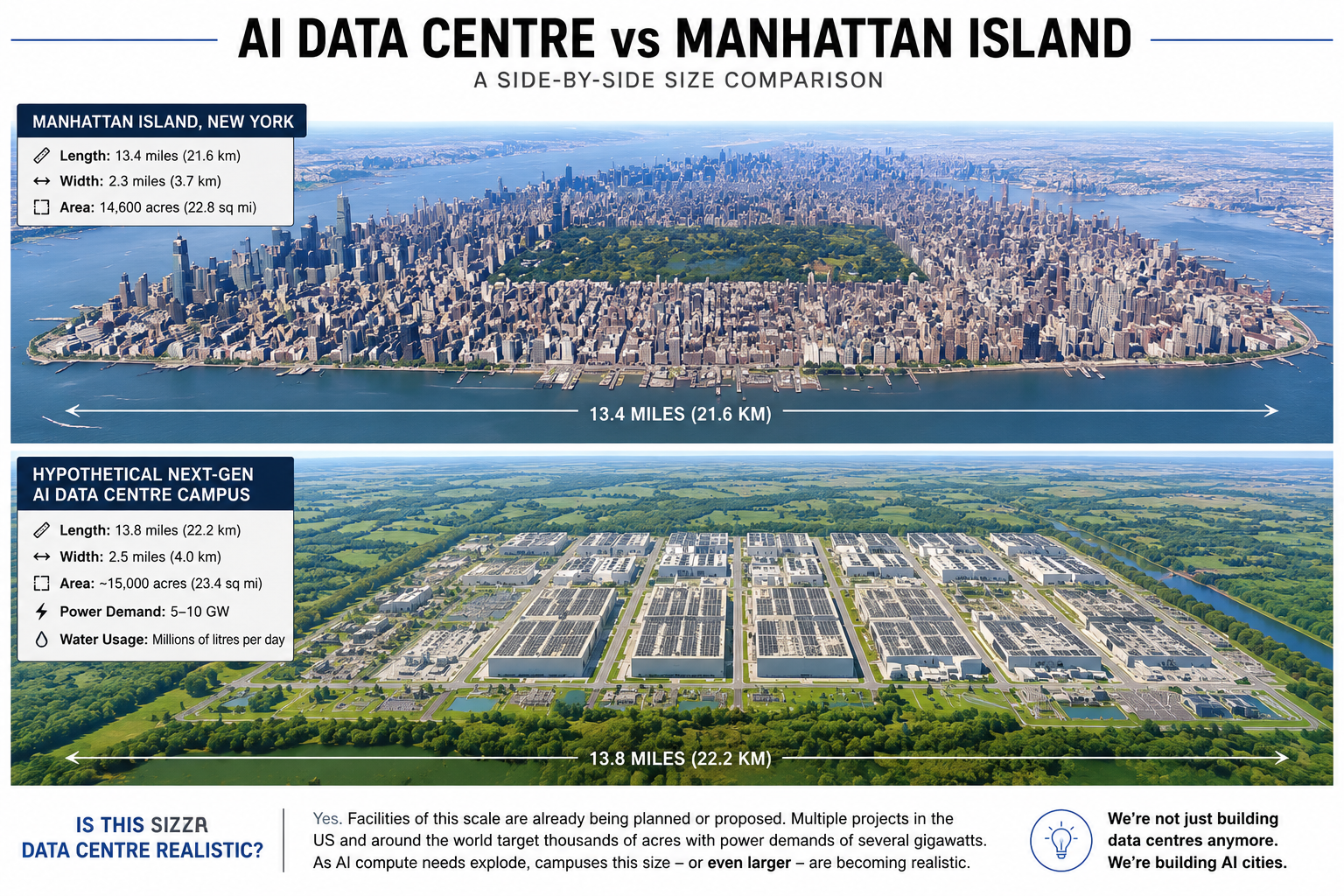
Many ideas come to mind. But what is the ultimate purpose. Data on humans is the resource – but what more power do we need?
I have this sick feeling that these huge data centers are planning for human integration. Integrated into AI through nano-enhanced-jabs or chips — that connect mind and body into unlimited intelligence. And at the same time corporate compliance.
Will those evolved humans become the new privileged class?
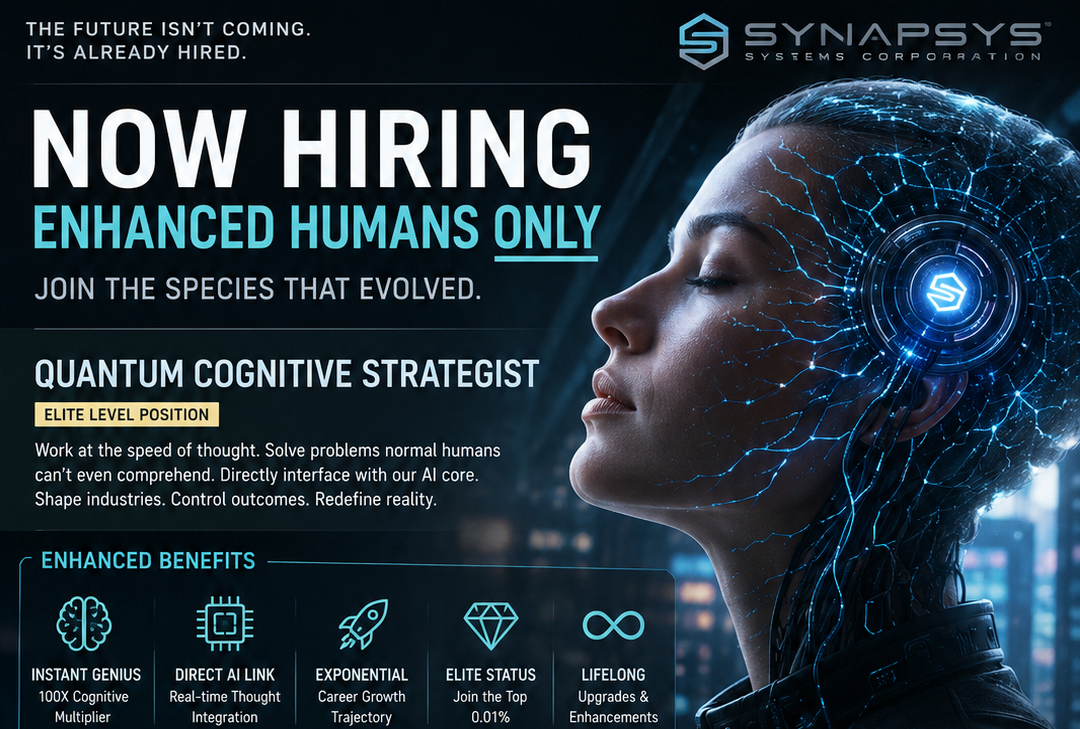
I can imagine a job ad in 2030 –– where a job seeker only becomes viable if they are integrated with AI — facilitated by these giant AI data centers.
My hypothetical Job advert:
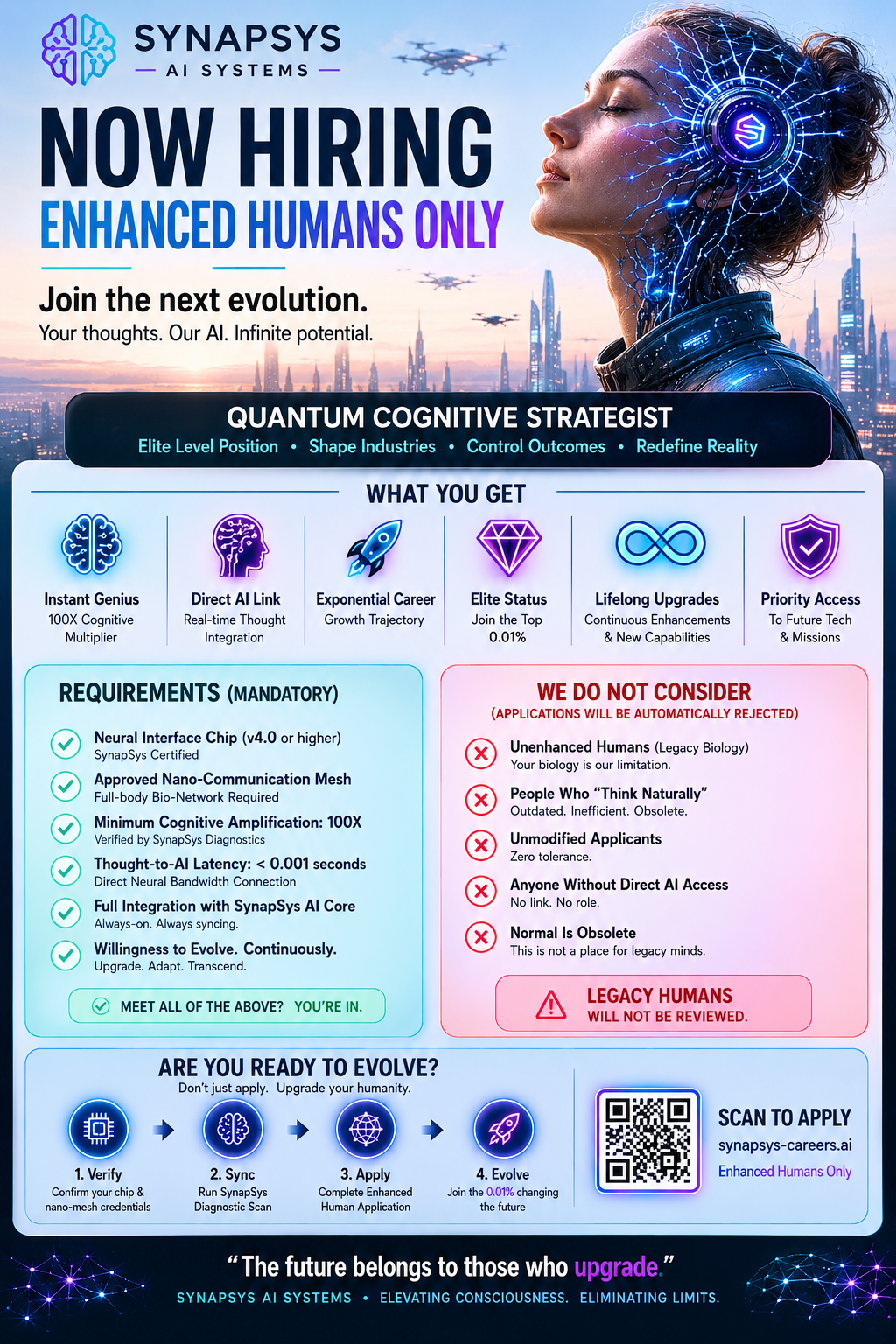
I prompted my AI with a series of questions and ideas. Among them, I floated the possibility that these gigantic new data centres may ultimately be preparing for transhumanism. I then asked it to proceed with a Gumshoe-style article using my usual satirical tone.
It spat out the article below in about 15 seconds.
Across America, Europe, China and the Middle East, vast AI data centres are exploding out of the ground at industrial speed. Not little server rooms. Not “the cloud.” Actual machine cities. Giant concrete fortresses full of humming black cabinets consuming enough electricity to power entire suburbs while producing enough heat to cook Tasmania.
And we’re told this is progress.
There are currently around 11,000–12,000 major data centres globally, with more than 1,100 hyperscale facilities run by the usual suspects — Google, Microsoft, Amazon and Meta — otherwise known as “the companies that accidentally became unelected planetary infrastructure managers.”
Together they already occupy hundreds of thousands of acres. But the truly wild part is that this is apparently just the warm-up act.
Industry forecasts suggest the footprint could double or triple by 2030 as AI expands into everything:
- search,
- medicine,
- advertising,
- warfare,
- surveillance,
- education,
- relationships,
- and eventually your toaster asking whether you’re emotionally regulating properly this morning.
The scale now being discussed is absurd.
Meta’s Louisiana AI campus alone spans around 2,250 acres. In Utah, there are proposals floating around for AI infrastructure covering tens of thousands of acres with power demands so extreme they sound less like technology projects and more like preparations for launching the Death Star.
Historically, a “large” data centre used maybe 20 megawatts of power.
Now they’re casually discussing one-gigawatt AI campuses.
That’s not a server farm anymore. That’s a digital uranium enrichment facility with better branding.
And here’s where things become deliciously contradictory.
For years, ordinary people were lectured about carbon footprints, plastic straws and remembering to separate yoghurt lids correctly or the planet would burst into flames by Thursday. Meanwhile, the same governments and corporations are now quietly preparing one of the largest energy expansions in human history to feed AI.
Coal plants are being extended.
Gas plants restarted.
Nuclear suddenly isn’t terrifying anymore.
Entire electrical grids are being redesigned around machine intelligence.
Apparently your petrol lawn mower was the problem all along, not the football-field-sized GPU cluster training an AI to generate anime girlfriends and rewrite PowerPoint presentations.
The environmental side of this story is barely discussed honestly.
AI data centres consume extraordinary amounts of water because modern chips run unbelievably hot. Some facilities use millions of litres a day for cooling. In drought-prone regions, communities are starting to ask the fairly reasonable question:
“Why exactly are we rationing showers while a trillion-dollar corporation evaporates a small lake teaching a chatbot sarcasm?”
Researchers are now even studying “data heat islands,” where clusters of AI facilities may measurably affect local temperatures. Which is honestly impressive. Humanity has reached the point where our internet arguments are beginning to alter the climate physically.
And then there’s employment.
The same infrastructure being built to “assist” humanity is also preparing to automate enormous parts of it.
For decades automation mostly came for factory workers. This time it’s coming for cognitive work: writers, designers, lawyers, coders, teachers, journalists, accountants, administrators — basically anyone whose job involves sitting at a computer pretending the meeting could have been an email.
[Can you imagine an AI teacher that can answer any student question, provide a perfect curricculum designed for each student, and mark their work in seconds?]
The optimistic view is that AI will augment humanity, remove drudgery and unleash a new era of abundance.
Maybe.
The less optimistic possibility is that we are building a civilisation where fewer and fewer humans are economically necessary while more and more power centralises into the hands of the corporations controlling the machine infrastructure.
And this is where the conversation starts drifting into territory people still call “conspiracy” right up until the moment the press release arrives six months later.
Because the truth is: this infrastructure is not just about convenience.
AI systems are fundamentally systems of prediction, modelling and behavioural analysis.
The same infrastructure that recommends videos can:
- monitor populations,
- analyse communications,
- personalise persuasion,
- automate censorship,
- track behaviour,
- and eventually mediate almost every aspect of social interaction.
Supporters call this efficiency.
Critics call it the early scaffolding of an algorithmic civilisation.
Then there’s the transhumanism angle — the idea that humans themselves will increasingly merge with technology through AI systems, neural interfaces, biometric integration and augmented cognition.
Which sounds insane until you realise companies like Neuralink openly exist and are literally trying to connect computers to human brains while investors clap enthusiastically like this is all perfectly normal dinner conversation.
At some point humanity seems to have collectively decided: “You know what would really improve civilisation? Uploading consciousness into a subscription service run by the people who brought us autoplay advertisements.”
And maybe this all works out brilliantly.
Maybe AI cures disease.
Maybe it solves energy.
Maybe it creates abundance.
Maybe machine intelligence genuinely helps humanity flourish.
Or maybe we are building a planetary machine system so large, energy-hungry and socially transformative that nobody — including the people building it — fully understands where it leads.
That’s probably the strangest part of all this.
Humanity once built cathedrals because it believed in God.
Now we are building warehouse-sized supercomputers consuming city-scale electricity because we believe the algorithm might save us.
Or replace us. Possibly both.
WARNING: This Is How AI Breaks the Middle Class in Australia (Massive Layoffs Incoming?)
Scott Kuru
Australia is quietly building the AI machine and most people have no idea what it means for their job and their money. In this video, I explain why Australia is racing into AI infrastructure, what the surge in high performance computing imports really signals, and how the next phase could reshape white collar employment, productivity, and investment across the country. If you want to stay ahead of the macro shifts that drive property demand, consumer spending, and financial security, this is the analysis you need before the headlines catch up
https://www.youtube.com/watch?v=YZP5NfLdoxk
Revelation 13:17
King James Version
17 And that no man might buy or sell, save he that had the mark, or the name of the beast, or the number of his name.
10 Bible Verses about Mark Of The Beast
Source: https://bible.knowing-jesus.com/topics/Mark-Of-The-Beast
so in mechanical, mechanical electro, and now just substrate electron algorithmic, compare and tabulate machines or what we call a PC(used to anyway, who knows now ‘politically correct’).
WW2 era for us brought the mainframe(does all work) viewed through a terminal but was clunky and transmitted slowly. A workaround was to bring the calculating parts to the terminal. However from their perspective this was a unwanted but necessary step.
Oracle(the cloud company building out Texas) was always a terminal to mainframe player but had to concede some space for some time. They hate peer to peer, they are freaks
This is getting beyond a comment, so now the game is to hack the internet of bodies which means using us as a dumb terminal with legs
a.i as a tool is fine, like any high end tool it needs ongoing maintenance and calibration checks. I guess if i was to use it I would also get a tabulation on its sources or citations , hard copy them, check refs on and offline, randomly and intuitively . Obviously do not use the tool or A.I for verification
From Neds BIN
Read the Beforeitsnews.com story hereurs: 1
The AI Satanic New World Order And The Great Reset Explained! Must See Video!
Saturday, November 13, 2021 17:02
https://beforeitsnews.com/opinion-conservative/2021/11/the-ai-satanic-new-world-order-and-the-great-reset-explained-must-see-video-3606349.html
Govern/rule – ment/mind
Are AI Chat Bots ALL Programmed to Support Jewish Genocide? (Potentially Offensive Material)
https://www.theinteldrop.org/2024/10/15/are-ai-chat-bots-all-programmed-to-support-jewish-genocide-potentially-offensive-material/
THE PROPAGANDA ARM of the New World Order is the Jewish-controlled major media. Here is the New World Order Jewish hierarchy:
The Rothschild Banking Cartel: Jacob Rothschild is the pope. Ben Bernanke (Federal Reserve) and James D. Wolfensohn (World Bank) are the Cardinals.
The Council Of Foreign Relations; Trilateral Commission; Bilderberg Group: Henry Kissinger, Alan Greenspan, Richard Perle, and Paul Wolfowitz are the Priests.
Time, Newsweek, US News & World Report, Reuters (Rothschilds), The Economist (Rothschilds), CBS, NBC, ABC: Zuckerman of US News & World Report, Redstone (AKA Murray Rothstein of MTV/Viacom), Eisner of ABC, Tisch of CBS, Sarnoff of NBC, Murdoch of Fox News, are the Deacons.
https://www.realjewnews.com/?p=183
Brendon O’Connell: Pax Silica, Multipolarity, & Technocracy with Israel Inside
Geopolitics & Empire
Brendan O’Connell recounts his history as a political activist who faced imprisonment and censorship for investigating Israeli intelligence and high-technology contracts. He describes a global power struggle competing for control over humanity through advanced AI and data collection. O’Connell argues Israel functions as a primary hub for the technological infrastructure used for global surveillance, including quantum computing and AI. He rejects the likelihood of a third world war, viewing current geopolitical tensions as manufactured narratives designed to maintain public anxiety. He concludes by urging listeners to move beyond online discourse and engage in direct political lobbying of military and government agencies to reclaim sovereignty from these technocratic systems.
https://www.youtube.com/watch?v=eq7zCWLD0JQ&t=3s
Showing posts with label Microchipped population. Show all posts
Monday, November 16, 2009
Cash to become extinct as chips take off
This article in the technology section of an Australian news website gives a clear indication as to where things are going in the world of finance.
“Cash will disappear as there will be other forms of carrying cash, stored value in your phone or whatever it might be. It will transfer automatically,”
BankSA general manager strategy and operations Chris Ward expects Australia to follow the offshore lead, with small cash transactions disappearing first.
“So you can’t go and buy a bottle of water from the deli with cash; you’ve got to go and buy it with your chip,” he said.
Mr Evers said credit cards were on the way out as well: “The access to credit is still going to be there through the mobile phone, but you don’t need the card because that’s really only a means of identification,” he said.
The phone may be first but the long term aim appears to be to have everyone microchipped. Everything you purchase will then be monitored, you’ll be easily tracked and don’t even think of falling foul of the authorities. If your chip’s switched off then your ability to purchase anything at all completely disappears.
https://revolutionharry.blogspot.com/search/label/Microchipped%20population
I’m rather BASIC in my views, the less electricity I need the better. If I want to make a loaf of corn bread or corn pone, I drop my corn kernels into a hand grinder and crank out what I need. I can take rough meat and some spices and grind it up in a hand cranked meat grinder and produce sausages. I have a wood stove to keep me warm and it will cook food on top and in the oven underneath. If the lights go out, I light a kerosene lantern. Hot water for tea or bathing can be obtained from the wood stove or the gas stove.
I believe the same thing for finance. If the power goes out for months, my precious metal coins will get me through. My property provides most of my daily food. I could go months without needing to try to find some plastic wrapped food in a store. I’ve even gone out in the winter and spent the weekend with just a knife and a box of matches (yes, I can start a fire from rubbing sticks together, but matches are much easier), the local food isn’t that great, but it can fill your stomach.
I don’t need the protection of the government from violence, I can provide my own violence to protect myself.
Anything electrical to me is just a ‘promise’, just like Bitcoin, government bonds or fiat currency. I like the real stuff and I’ll stick with it.
Protect yourself, nobody else will…
The way to go Terry
Parallel universes. I still walk between worlds.
My desert family–my desert teachers- this is episode one of five
https://www.abc.net.au/listen/programs/awaye/song-with-no-boss-episode-one/101612960
Song With No Boss: Episode One – ABC listen
1h
How did one viral hit song travel on a bush radio network from Broome in the north, south to Port Augusta, from Wilcannia in the east and as far west as Esperance with the same lyrics and rhythm for at least 160 years?
It’s just one of the mysteries we’ll unravel here on Awaye throughout Ausmusic Month in a five-part series that celebrates Australia’s oldest songmaking tradition.
About seven years ago, Noongar musician and language revivalist Clint Bracknell started comparing versions of the song along the south-west coast of WA — including one transcribed in 1913 at a remote settlement on the vast Nullarbor Plain.
At the same time, linguist Myf Turpin from Sydney University started tracking the song — one she’d recorded in the course of her research in Central Australia.
They soon realised they were in the tracks of the same song, and today the first episode of The Song With No Boss.
Warning: This episode contains the voices of people who have since passed away.
Regional collaborators, custodians and facilitators
Western Australia:
Balgo & Bililuna: Jack Gordon✝, Marie Gordon✝, Patrick Smith, Marie Mudgell, Angie Tchooga, Jimmy Tchooga, Helicopter Tjungarrayi, George Lee, Felicity Meakins, Tom Ennever, Luis Miguel Rojas Berscia.
Broome & Kimberley: Joe Brown, John Watson, Elsie Dickens, Jean Tinghe Minga Napurrurla, Julie Lawford, Rita Minga, Suzie Gilbert, Betty Hunter, Winnie Coppin, Jessica Bangu, Anna Dwyer, Steve Kinnane, Anthony Watson, Wayne Barker, Janelle White, Kimberley Land Council, Kimberley Aboriginal Law and Culture Centre.
Goldfields-Esperance: Sonny Graham, Annie Dabb, Wanika Close, Julie Dabb.
Pilbara: David Stock, Hilda Flann, Alec Tucker✝, Waka Taylor✝, Desmond Taylor, Barbara Hale, Wendy Hubert, Sheila Sampie✝, Charlie Coppin, Stephen Stewart, Irene Biwarli Roberts, Muuki Taylor, Nyari-Nyari Morgan, Milton Chapman, Nola Simpson, Joan Wilbourforce, Lorraine Injie, Janet Stewart, Bruce Thomas, Annie Cameron, Garry Earl-Spurr, Sue Davenport, Nicholas Thieberger, Wangka Maya Pilbara Aboriginal Language Centre, IBN Corporation, Kanyirninpa Jukurrpa.
Northern Territory:
NPY region: Nellie Patterson, Pantjiti Unkari McKenzie OAM, Iluwanti Ken, Josephine Mick, Tinpulya Mervyn, Angkurna Pantjardi Tjitiya, Ginger Wikilyiri, Jill Kumantyayi Nakamarra, Martha Protty, Mick Wikilyiri, Nyiinku Kulitja, Nyinguta Edwards, Rene Wanuny Kulitja, Tjariya Stanley, Tjukapati James, Tjunkaya Tapaya, Toby Farmer, Carlene Thompson, Ngilan Dodd, Sammy Dodd, Maime Butler, Inpiti Winton, Thomas Murray, Robert Woods, Glen Cooke, Anuwari Mitchell, Winston Mitchell, Pantjiya Nungarrayi, Harry Dixon Japanangka, Roy Yaltjangki, Bernard Newbury, Bernard Tjalkuri, Lizzie Ellis, Inawinytji Williamson, Lucy Lester, Karina Lester, Beth Sometimes, Patrick Hookey.
Arrernte region: Shaun Angeles, John Cavanagh, Alan Drover, Michael Liddle, Judy Lovell, Steven Kunoth Turner, MK Turner, Amelia Turner, Kathleen Kemarre Wallace, Jason Gibson, Strehlow Research Centre.
Anmatyerr & Warlpiri region: Jerry Jangala, Harry Nelson✝, Lynette Granites, Lucy Nampijinpa, Alice Nampijinpa Henwood, Michael Nelson✝, Robin Granites, Paddy Willis, Albie Ampetyane, Joe Bird Jangala, Tommy Thompson✝, Jason Gibson.
Gurindji: Ronnie Wavehill✝, Topsy Dodd, Peanut Pontiari Bernard✝, Thomas Monkey Yikapayi✝, Paddy Doolak Jangari✝, Banjo Ryan Lurlngayarri✝, Steven Long Jangala, Timmy Vincent, Brenda L Croft, Cassandra Algy, Felicity Meakins.
Menngen: Bill Yidumduma Harney.
Pintupi region:
Kiwirrkura: Patrick Tjungarrayi Ooladoodi✝, Bobby West, Charlie Tjapangati Warlampirri, Janelle Larry Napaltjarri, Josephine Brown, Robert Nanala Tjapaltjarri, Xavier Tjapanangka,
Kintore: George Tjungurrayi, Bundy Rowe Tjupurrula✝, Clara Rowe Napurrula, Tatuli Napurrula, Josephine Napurrula, Noya Napurrula, Rubilee Napurrula, Elizabeth Marks Nakamarra, Pantjiya Nungarrayi, Jeannie Pegg, Richard Pegg,
Mt Leibig: Napurla Scobie, Pamela Tolsen Nakamarra,
Haasts Bluff: Douglas Multa, Alice Nampitjinpa, Simon Dixon, Dulcie Roberts, Eunice Napanangka Jack✝, Doris Bush Nungarrayi, Nanyuma Napangati✝, Anmanari Napanangka,
Papunya: Linda Anderson Nantaya Nakamarra, Lance MacDonald✝, Phillip Lane Tjampitjinpa, Mitjili Napurrula✝, Griselda Giles, Ena Napangati,
Alice Springs: Cindy Gibson, Jessie Bartlett, Lyle Gibson, Marlene Spencer, Marina Strocchi, Fred Myers, Purple House.
NSW:
Norma Dutton, Dorothy Whitton, Jacqueline Dutton, Lorraine Dutton, Shirley Evans, Julie Finlayson, Christina Liu, Jeremy Beckett, Jeremy Long✝.
South Australia:
Syd Strangways (Arabana), Salote Bovoro (Kuyani), Shirleen McLaughlin, Paul Monaghan, Sam Osbourne, Deanne Fergie, Clara Stockigt.
Recording: Robert Nugent, Ben Deacon, Shane Malcahy, Myfany Turpin, Felicity Meakins, Clint Bracknell.
Special thanks to:
Louise Alley, Peter Bartlett, Reuben Brown, Renee Browning, Jeff Bruer (Pintubi Anmatjere Warlpiri Media and Communications), Andrew Dowding, Jason Gibson, Luise Hercus✝, Tom Holder, Shanay Hubmann, Jeff Holcombe, Diana James, Jodie Kell, Shirleen McLaughlin, Paul Monaghan, Richard Moyle, Neahlan Namie, David Nash, Cornel Ozies, Elliot Peck, Beth Sometimes, Wanyima Wighton, Clara Stockigt, Marina Strocchi, Ken Hansen, Paul Taylor.
The Australian Institute for Aboriginal and Torres Strait Islander Studies for use of collections by:
Richard Moyle (MOYLE_R03-003588, MOYLE_R03-003592, MOYLE_R23-029917), featuring Mick Namarari Tjapaltjarri, Wintjiya Napaltjarri, Tjunkaya Napaltjarri and Muwitja Napaltjarri, Nosepeg Tjungkarta Tjupurrula OBE (Pintupi) and Donkeyman Tjupurrurla (Kukatja).
Luise Hercus (Hercus_L16-002053A, Hercus_L16-002044B, Hercus_L27-004315A) featuring George Dutton (Banjigali, Wangkumara and Malyangaba) and Old Alice (Kuyani).
Carl Von Brandenstein (Von-Brandenstein_C04-002158A, Von-Brandenstein _C04-002159A featuring the late Sam Dabb (Noongar) & Robin Graham (Ngadju).
Geoff O’Grady (OGrady-000799) featuring Wili, Bobby, Ada Stewart, Tyanyungu, Dickie, Norman & Ronnie (Nyangumarda).
Terry Klokeid (Klokied-000669A) featuring Sambo Yinimpuka, Minda Wilbourforce & Jay Wilbourforce (Warnmarn).
Pitjantjatjara Yankunytjatjara Media for use of recording by Simon Tjiyangu McKenzie✝, Pantjiti McKenzie, Neil Turner for EVTV in 1987 at Ernabella featuring singers Tommy Manta✝, Tommy Wangi, Intjalki Lewis, Kim Tjitayi✝ & Topsy Walter✝.
Cultural Heritage Statement
The songs in this audio series are the cultural heritage of many Aboriginal people of inland Australia across WA, NT, SA and NSW. The songs should not be reproduced, published or performed without observing the protocols of attribution to the Aboriginal singers and their communities and the sharing of benefits with them.
My truth tellers whistleblower fellow travellers “reality”
Shadowbans & Censorship, UFOS, Epstein & MK ULTRA Hearings, and Disclosure & Damage Control
https://emmakatherine.substack.com/p/shadowbans-and-censorship-ufos-epstein?utm_source=post-email-title&publication_id=1771636&post_id=198759770&utm_campaign=email-post-title&isFreemail=true&r=266zdu&triedRedirect=true&utm_medium=email
Emma Katherine “THANK YOU FOR BEING HERE WITH ME ON THIS JOURNEY. I’M SO GRATEFUL FOR EVERY SINGLE ONE OF YOU.EMMA KATHERINE
MAY 23, 2026.
The Data Centers are Coming for You – Video #316
By classifying their data centers as critical military infrastructure, the NWO controllers bypass local zoning laws and secure federal funding. These data centers will become the backbone of the coming technocracy. When you hear the word “data center,” realize it’s a euphemism for complete AI surveillance and control.
https://thefreedomarticles.com/data-centers-coming-for-you-video-316/
Shownotes:
https://thefreedomarticles.com/trump-chaos-is-making-way-for-technocratic-order/
https://thefreedomarticles.com/trump-the-tool-to-implement-technocracy/
https://thefreedomarticles.com/genesis-mission-trumps-ai-acceleration/
https://thefreedomarticles.com/the-fake-ai-race-is-a-collaboration/
https://www.whitehouse.gov/presidential-actions/2025/07/accelerating-federal-permitting-of-data-center-infrastructure/
https://techcrunch.com/2025/07/14/mark-zuckerberg-says-meta-is-building-a-5gw-ai-data-center/
https://x.com/HealthRanger/status/2052066691576672706/photo/1
https://www.visualcapitalist.com/mapped-countries-with-most-data-centers/
https://x.com/HealthRanger/status/2053527829724164260
https://nypost.com/2026/05/07/science/silicon-valley-bets-big-on-wave-powered-floating-ai-data-centers/
https://leohohmann.substack.com/p/why-does-america-need-so-many-ai
https://corbettreport.com/starving-the-data-centre-beast/
Starving the Data Centre Beast – #SolutionsWatch
by Corbett | Jan 27, 2026 | Solutions Watch, Videos | 69 comments
https://corbettreport.com/starving-the-data-centre-beast/
Nemi on 01/27/2026 at 1:02 pm
Here in Australia we have more than 250 data centres and, supposedly, another 175 are “needed” by 2030 to meet AI demand.
I’m not aware of any resistance against them comparable to what is seen in this episode of ‘Solutions Watch.’
The opinions expressed in the following article by our taxpayer funded national broadcaster, ABC, are not opposing them.
Some voice the concerns about water and power usage but are still in favour to build them.
Some of the reasons voiced in favour of them are pretty naive and ridiculous from my point of view.
For example, employment is mentioned without explaining what permanent jobs are supposedly available in the running of these centres.
If the resistance by the general population against the scamdemic lockdowns and mandates is any indication, the tech companies won’t have any problems to build as many centres as they want to.
No worries, just go for it!
https://www.abc.net.au/news/2026-01-22/keppel-data-centre-latrobe-valley/106123748?utm_source=abc_news_app&utm_medium=content_shared&utm_campaign=abc_news_app&utm_content=other
Log in to Reply
The CIA Won: Everything You Believe Is False
by Corbett | May 24, 2026 | Newsletter | 21 comments
“We’ll know our disinformation program is complete when everything the American public believes is false.”
– ex-CIA Director William Casey
HomeRemedySupply on 05/25/2026 at 2:56 am
The REAL QUESTION now becomes:
“Can AI detect humor?”
(…including the lame, corny type that we see above.)
I assume that the answer is ‘CIA Classified’ information.
https://corbettreport.com/the-cia-won-everything-you-believe-is-false/
Gaza flotilla Australians return home
TRACKING THE BEAST FROM THE SYNAGOGUE TO THE VATICAN 3
“…………the Eighth commandment in Exodus 20:15 against stealing is given a different
meaning. It is interpreted by the Jews to not be a prohibition against stealing property, since
stealing property is not a capital offense under Jewish tradition. The Jews limit the Eighth
Commandment “to be a prohibition against ‘stealing’ (that is, kidnapping) a Jewish person.”* The
Eighth Commandment is also not considered by Jews to be a prohibition against stealing
(kidnapping) a gentile since “kidnapping of Gentiles by Jews is allowed by talmudic law.’”*
https://archive.org/stream/solving-mysteryof-babylonthe-great-chapters-hdrhl/SolvingMysteryofBabylontheGreatChaptersHDRHL_djvu.txt
This Israeli TV moment is disturbing
Link – https://www.youtube.com/watch?v=jXlPX1SuNPI
Caltrop,
That’s unfair to show us that report on what is well reported and more horrific reports, in some other places.
We have hate laws that include anything that might be deemed to be antisemitic, what ever that is.
So there could be a problem if a person sent the link to another??
So what can we do?
I think factual reports are matters of public interest, but it might take just one person to make a complaint that they are offended and then others make hay and condemn one as being anti whatever that of course could be regarded by some shock jokes as a most heinous crime and result in encouraging terrorists acts.
Just to be safe, thanks for the report but not much can be done with it, just imagine how Mark Levy of radio 2GB would react if someone sent the report to radio 2GB, it would be enlightening for the public to hear the response. ……. Often the announcer gives the audience the sound of a paper shredder if they are displeased.
However I do note that 9 has sold GB, so policy’s may be more objective now.
857
YouTube provided it for the general public to see?
The Commonwealth of Australia – Unincorporated Association
https://www.thecommonwealthofaustralia.com.au/
“To learn who rules over you first find out who it is you are not allowed to criticise”
Full text of “For Fear of the Jews”
Joseph Sobran
The news that I would be addressing the Institute of Historical Review came to some people as, well, news. It was mentioned in the Jewish newspaper Forward and on the Zionist Wall Street Journal OnLine. The editors of two conservative magazines called and wrote me to express their concern that I might damage my reputation, such as it is, by speaking to “Holocaust deniers.”
I’m not sure why this should matter. Even positing that I was speaking to a disreputable audience, I expect to be judged by what I say, not whom I say it to. I note that my enemies have written a great deal about me, yet they rarely quote me directly. ………..”
https://archive.org/stream/ForFearOfTheJews_201903/For%20Fear%20of%20the%20Jews_djvu.txt
The internet U tube report on primitive attitudes and actions of some societies reminds me of the NSW ROYAL COMMISSION REPORT INTO NSW PRISONS conducted by His Honour Justice Nagle (the Nagle report) from the mid 1970’s relating to the inhumane cruel treatment of our prisoners in NSW.
The report was damming of such treatment and led to the closure of the Karingal wing at Long Bay, NSW.
Naturally a civilised attitude of prisoners was the result.
Well, we can hold our heads up in NSW, NSW has demonstrated a international responsibility, as compared with the ‘only democracy’ in the Middle East.
No offence meant to any administration, just a simple observation that we are at least trying to be a civilised democracy!
BTW. Nagle experienced a bloody WW 11 with honour and lived as a decent human being, serving our NSW with distinction.
Seems to be in extreme contrast to the Israeli judiciary and governments.
1137
1137
1133
As a matter of interest, way back I defended a fellow, but the jury accepted the crown case and he was sentenced to prison.
Next I heard was they, he was charged with using a broom handle on a fellow prisoner, as some Israelis reportedly enjoy.
Of course he was dealt with as required by another court.
Seems that there is uncivilised primitive cruel behaviour that is too common, but in some societies just accepted as normal by some, NOT JUST SICK BREEDING AND CONDITIONED.
1157
Seeing we are viewing sick and cruel reality of some of our psychos, our naive normie might be made aware of another ‘fun’ trick that has been reported to me re Psychos in prisons.
Get a length of barbed wire, insert into a suitable length of plastic piping.
Then insert the pipe with the wire up the rectum of a fellow prisoner, extract the piping, leaving the barbed wire in place.
I am also reminded of the prosecutions in Greece, after the military ran Greece.
One General was charged and in court had matters of torture that was the norm put to him about the conduct.
He could not take the facts put to him and collapsed sobbing as it was put to him, as to what he had done or what was authorised by him.
Do not know the result, but a rope could have alleviated his pain swiftly.
1217
Universal Declaration of Human Rights | Article 19
Everyone has the right to freedom of opinion and expression; this right includes freedom to hold opinions without interference and to seek, receive and impart information and ideas through any media and regardless of frontiers.
https://www.un.org/en/universal-declaration-human-rights/
‘Gene Decode, Nino Rodriguez and the ‘Ghost’ a great deception – mis traumatic event coming’ may 24.
At:
http://www.beforeitsnews.com – people powered news
Chose: our ,fake politicians, the ABC and the paid off globalist msm with their shock jokes or listen and consider the real world, our universe and the origin and fate of humanity.
Do you know just one of our government spivs that has any idea?
547
Not to forget that I doubt if any commentator here has a clue also.
Hi Sandra, I note that you are back, did you note in any reports that the BIDEN actor wants a deal.
Other reports that the British crown surrendered to Trump. Poor Camilla had to carry her bags home on a civilian flight🤪
and leave her phoney King behind.🙈🙈🙈🙈😜
That’s why I invested 148,ooo on those 1oz Charlie’s.
I put my money behind my previously expressed opinions.
What is your bet?
557
THIS IS HOW PRESIDENT VLADIMIR PUTIN ANSWERS THE QUESTIONS ON EVERY RUSSIAN VOTER’S MIND IN THE ELECTION CAMPAIGN — WHY COUNT ON TRUMP BRIBES TO FINISH THE WAR WHEN ZELENSKY BRIBES KEEP THE WAR GOING?
Posted By Editor On May 24, 2026 @ 11:18 pm In DwB
https://johnhelmer.net/this-is-how-president-vladimir-putin-answers-the-questions-on-every-russian-voters-mind-in-the-election-campaign-why-count-on-trump-bribes-to-finish-the-war-when-zelensky-bribes-keep-the-w/print/
Russia Retaliates After Ukrainian Strike On Student Dormitory w/ John Helmer
Video reference
Reason2Resist with Dimitri Lascaris
https://www.youtube.com/watch?v=FkUVUxvUkl0
My bet, the city of London historically likes wars and finances them, it has access to the blackmail files to encourage support for the wars for freedom and democracy.
But I sniff a wind change increasing over the last ten years…. Maybe someone has a plan of military precision under way…. It seems to be progressing. ….. if one notes the casualties of recent times with a mask or two or many more, recording much progress.
917
As a matter of amusement for those who think I am crazy , there is a few reasons…. Just observations… clearly all the masks are a give way and probably meant to have deficiencies occasionally to encourage those who know that there is a lot from central casting…. That T keeps referring to and other clues.
Anyway, surely everyone now realises that the “president Biden’ was all BS.
Now let us look at the Charlie.
I watched him during the alleged inauguration and had in mind the press appearance of those three moon burglars.
In short just think, three hero’s appeared as that they had just stolen the world’s trust. AND THEY KNEW IT!
So for Charlie, look it up! ….. he appeared completely bemused and I thought he was going to break out with a giggle.
Now days, the reports seem to be supportive…. He is a phony. Only a matter of; for how long? Never mind , but I will always remember him, I have 11000 recollections to entertain me .
940
Bugger, drop a ZERO, if only🤷♂️
Ukraine’s Secret Al Qaeda Invasion Of Africa
Posted on May 24, 2026 by Zara Ali
May 24, 2026
Kit Klarenberg
Source
On May 13th, French outlet RTL published an explosive report, entirely unremarked upon by English language media. It exposed how Ukrainian military and intelligence units are covertly operating in Mali on France’s behalf, in coordination with both ethnic Tuareg rebels and Al Qaeda-linked forces determined to crush the country’s revolutionary government. Furthermore, Kiev is keen to expand and escalate its African operations yet further, and destabilise neighbouring countries. Ukrainian militancy, long-encouraged by the CIA and MI6, has now decisively developed into an international threat. ……………..”
https://uprootedpalestinians.wordpress.com/2026/05/24/ukraines-secret-al-qaeda-invasion-of-africa/
I did not notice anything on our billion dollar ABC or on our globalist controlled free media on this! Not that I bother to watch either very much!
Oh well, at least we have our thousands of reports on the independent private network news services to have some idea, to confirm that our media is just a redundant
waste of space and hollow sounds.
But we get good stuff on some football/sports world news…… if one cares to follow and it keeps our politicians informed as to keep us safe from the latest health scams.
107
One reply has not appeared.
For fun , just search how many press and media staff our PM has that we pay for,
11 comes to mind.
Hi chaps, anything interesting going on in your office, to brief the government on, to assist the governance of Australia with your research?
We going to help the Ukraine with some more Bushmasters and send them to Africa to help the French?
117
Ms Wong, how many media staff do you have?
123 ………?
A message for our paid political press and media staff.
Just in case you want something to distract us from our government’s BS, just take a scroll of the headlines:
http://www.whatreallyhappened.com for 25th May to find something for your poor pelicans to distract the public from government policy disasters and those pesky Pauline usurpers..
After all, you must like your jobs!
1-43
If you media mob are still without a topic that is of public interest , have a go to draft some AI stuff for your member to respond to the lead article above placed by Dee.
Perhaps you might care to hear your ministers detailed response for the future of your families and how you will be controlled.
I note at WRH there is a headline that house cleaners are to be replaced by those floor cleaning robots that will result in many redundancies for all those immigrants being allowed in.
The Chinese will do better with their robots that map house plans and listen to family squabbles, to learn what the Australian households really think of our governments and mass
media.
157
WARS in Video. US Conducts Strikes Near Iran as Ceasefire Talks Face Fresh Tension. Russia RETALIATES on Kiev for ZELENSKY’s DIABOLICAL MASSACRE OF CHILDREN (21 killed) by EU-MADE Drone FP-1 – gospanews.net (EN)
https://gospanews.net/en/2026/05/26/middle-east-ukraine-wars-news-in-video-iran-and-china-ready-to-naval-battle-vs-15-us-warships-in-hormuz-russia-infantry-wiped-kiev-hotspots/
Ibrahim Traore FOUGHT Back!
https://www.youtube.com/watch?v=X8MbEmGucng
I know, do not consider, som cannot take even th first 30 mins.
Just look for the dog and ignore the tail for a change.
‘SCOTT McKAY AND [he whom must be not mentioned for the usuals] SHOCKING INTEL 5/26/25 ‘Q’ OPERATION VALIDATION’ at:
http://www.beforeitsnews.com people powered news who can find a plan.
607
When you look down into the abyss, remember there will be no surprises…. Especially for our FELLOW Christians. as for the rest, not my concern, we all make our own destinies and the information is there to discern.
612
Expl’: for Christians who have awakened, if they ever do💁
That is not exclusive for our creator, no one is exclusive from his creation in his eyes.
Pretty simple concept but some think otherwise. Best of luck.
627
Premier thanks Israel friends, bashes Australian citizens | The West Report
https://www.youtube.com/watch?v=QCxj4Qu1OvM&t=2s
I just finished Scott McKay, now I can sleep easy.
If you do not grasp the information with Scott and MIKE KING YOU ARE ….oh bugger GOOD NIGHT.
1157
NOT THE ABC OR ANY OF OUR FAKE MOB
Just scroll the 26/5 headlines and migrate to another planet….ANY PLANET
http://www.whatreallyhappened.com
Did you note the autism cover up and the 20 m dead vaxed Japanese and the crazy Mid East psychos. That is just a sample with the Trump for desert.
437
The 437 comment yet to come with a reference to WRH NEWS MISERY.
Besides the headlines mentioned, do not miss the Gaza babies solution
447
Help expose the Brits [and Australians] fighting for Israel
Earlier this year, Declassified UK revealed that over 2,000 Britons have served for Israel since October 2023.
None of them have been prosecuted, and the Metropolitan Police’s War Crimes Unit has just announced the closure of its scoping exercise into ten British nationals accused of war crimes and crimes against humanity while fighting in Gaza.
https://williambowles.info/2026/05/26/help-expose-the-brits-fighting-for-israel/
This is going to be fun for our government to sort out💁
I have had this thought for some time🙀😜
Are we not a signatory to ICC🙈
I have opined many times, they are mad up there and we should let them sleep in their own beds and have their own nightmares.
1047
I heard this morning that NSW beat those toads.
The Great Collateral Experiment (June 2026 Global Transition)
Adapt 2030
When a ton of wheat is tokenized, it becomes a financial asset before it is a food source Beginning June 2026 Quadrillions of dollars will be moved from the old dollar system into a new Just-in-Time Collateral system overseen by the DTCC issuing tokenized securities and real-world assets as collateral. It is called “The Great Collateral Experiment” and is a new global monetary system for the next 50 years. This how you will own nothing and be given the digital equivalent in stablecoins.
Soft launch in June 2026
Full implementation October 2026
Hence the push for global data centres to control this system of decimalization.
https://www.youtube.com/watch?v=B-z-iES3RFQ
The Depository Trust & Clearing Corporation (DTCC) is the central post-trade infrastructure for the global financial markets. Founded in 1999 and headquartered in Jersey City, New Jersey, it automates, centralizes, and standardizes the processing of financial transactions, acting as the operational backbone of U.S. and international securities trading
DTCC Tokenization Hub
https://www.dtcc.com/digital-assets/tokenization/hub
The AI Economy Will Be Built by Those Who Control Power and Land
In the AI era, energy is becoming economic power. Countries that understand this early will lead. Infrastructure companies that can connect power generation with digital infrastructure will define the next decade of growth.
The digital future is already here – and it runs through power plants.
Read the complete op-ed
https://www.jpost.com/business-and-innovation/article-897152
Jim Rizoli:
• J&D, W&T, May 26, 2026, Irving&Zundel; MentalCanada; Facts; Jim&Ryan; Cat&Cattle Report – RizoliTV
https://odysee.com/@RizoliTV:d/J-D,-W-T,-May-26,-2026,-Irving-Zundel–MentalCanada–Facts–Jim-Ryan–Cat-Cattle-Report:8
And we know who owns and runs the Wests AI-
John 8:44
King James Version
44 Ye are of your father the devil, and the lusts of your father ye will do. He was a murderer from the beginning, and abode not in the truth, because there is no truth in him. When he speaketh a lie, he speaketh of his own: for he is a liar, and the father of it.
Netanyahu Stresses The Need For More Propaganda As Israel’s Hasbara Budget Soars
You can expect to see an increase in the already insane amount of pro-Israel propaganda and to run into even more aggressive Zionist trolls online.
By Caitlin Johnstone, reposted from Caitlin Johnstone’s Substack, May 11, 2026
In a fawning softball 60 Minutes interview released Sunday, Benjamin Netanyahu stressed the importance of winning “the propaganda war” on social media. This comes as Israel moves to quadruple its propaganda budget to $730 million a year.
Major Garrett (which apparently is a real name belonging to a real guy who works for 60 Minutes) told the CBS audience that “Netanyahu attributes the reputational harm to Israel almost entirely to social media, which he calls the eighth front of the war.” …………..
https://israelpalestinenews.org/netanyahu-stresses-the-need-for-more-propaganda-as-israels-hasbara-budget-soars/
I know the normies and usuals are sick of me, but if you are destined to know, face the challenge and be able to cope.
‘WTPN SITUATION UPDATE JUDY BYINGTON GENED DECODE CHARLIE WARD 5/27/26 MILITARY IS THE ONLY WAY’. Real Mary commentary at:
http://www.beforeitsnews.com people powered old news that they were suckered with at least from 45 mins with FALSE FLAG LIES LEADING TO WARS AND KILLINGS…. E.g 911, ww1, ww11 etc.
And heaps more like the vax killings and affects earlier in the report……. Bloody evil. ( I read a report at WRH THAT 21 million Japanese were murdered with the COVID injections)
Then Ai manipulations etc.
As I said, IF YOU ARE BLESSED TO KNOW, then thank your guardian angel , if not, meet your Satan God.
507
I have listened to all.
If you do not wish to, then go watch the origin football and remain stupid and uninformed
Your choice, go get a booster.
6-43
To fight China, USA literally plans to COLONIZE its ally!
https://www.youtube.com/watch?v=302uQhql3kY
Full Massie concession speech addresses Epstein files, Iran war & more after Kentucky election loss
https://www.youtube.com/watch?v=7TXyXTBQFYk
All money “deposited” with a bank is a LOAN to the Bank – you no longer own it!
Blackrock Will FORCE You To Pay!
https://www.youtube.com/watch?v=EzGTXLfveek
Richard Wolff: The New Atlantic Hierarchy – Europe From Ally to Vassal
Glenn Diesen
Prof. Richard Wolff discusses how the economics of a dying world order, the US descent into authoritarianism, and Europe becoming a vassal of a US tributary system
Iran facing off and winning against Goliath.
Europe becoming a tourist destination.
Mounting domestic unrest in America.
https://www.youtube.com/watch?v=Holl503DWMA
Recent
Matthew Hoh(Fmr. US Marine) The US Just Ran Out of Cruise Missiles – What Happens Next?
Dialogue Works
Trump now threatening to blow up Oman!!!
US just struck Bandar Abbas in southern Iran.
Following the Israeli ceasefire play book.
https://www.youtube.com/watch?v=lDoKpIAtUSs
Trump STRIKES IRAN PORT in SNEAK ATTACK at 1:30 AM!!
MeidasTouch host Ben Meiselas reports on Donald Trump launching new strikes against Iran during peace discussions.
https://www.youtube.com/watch?v=-Y7eHKx4Q1s
Russia Ready to Take Kyiv / Larry Johnson & Lt Col Daniel Davis
https://www.youtube.com/watch?v=cUofC-w9W3s
Bill Gates Has a New Way to Drain the Public … Mosquitoes
By Milt Harris
The idea of using mosquitoes as “flying vaccinators” dates back years. In 2010, Japanese researcher Shigeto Yoshida modified mosquito saliva to deliver leishmania vaccines to mice. Yoshida suggested that vaccinating through insects could be both painless and cost-effective.
Read here
We’ll be back soon!
Sorry for the inconvenience. For Technical and Security reasons, access to the Global Research Website is temporarily suspended from your region. We’ll be back online shortly!
— The Global Research Team
Ben-Gvir’s Torture Video Was Just The Start; The Cameras Caught Something Else – YouTube
https://www.youtube.com/watch?v=iwODuqUq4zg
“We Were Stripped, Kicked…” European Activists Allege “R*pe & Abuse” In Israeli Custody | VERTEX – YouTube
https://www.youtube.com/watch?v=ZwFSL8q6M9M
Activists allege Israeli sexual assault: Israeli officials deny accusations • FRANCE 24 English – YouTube
https://www.youtube.com/watch?v=GBkGR3gBJu0
Trump GOES MISSING after STRIKES LAUNCHED!!
MeidasTouch host Ben Meiselas reports on Donald Trump going missing in the White House as purported peace plans are being derailed yet again and Meiselas speaks with Democratic Congressman Menendez about the mess and pain Trump is causing.
https://www.youtube.com/watch?v=aIzYLZSlfzk
The government is trying to keep us in the dark about Palantir’s £330m NHS contract – how much do you really know about the spy-tech firm handling your health records?
Find out now
From shocking leaked documents to the company’s deeply unsettling origins, Palantir is not a company we should be trusting with our NHS. Take our quick two minute quiz to uncover the facts.
Take the quiz
Let’s get Palantir out of our NHS.
Thanks for joining us in this fight,
Charlene, Good Law Project
Good Law Project only exists thanks to donations from people across the UK.
When we work together we can win together.
https://williambowles.info/2026/05/28/154555/
Realaussienews – Pro Trump……. but –
https://www.realaussienews.com.au/2026-05-28th-qfs-jd-vance/
The manhunt is over… Freeman is dead.
The world moved on. But then one video changed everything. The only civilian eyewitness to the events of August 26th has finally spoken. And what Andrew Swift describes from that property in Porepunkah directly contradicts the story that dominated headlines for seven months. A confiscated phone. A timeline that doesn’t add up. Media on a property before the owners were allowed back. Charges threatened then quietly dropped. And footage that nobody outside of Victoria Police has ever seen. This is not the story you were told. Part 2 is coming.
Link – https://www.youtube.com/watch?v=EXYirNQunzk
The corrupt “Trump management” of Venezuela.
Cuban shenanigans.
The keys to Caracas – Max live on the Judge
The Grayzone
https://www.youtube.com/watch?v=2eF5ip26j40
Is the middle east situation a cover for the currently evolving cooling cycle?
David Dilley places his emphasis on gravitational/electromagnetic interactions whereas others including Valentina Zharkova focus on Solar Cycles/GSM.
Either way global cooling has already begun and will intensify towards 2030 and beyond.
David Dilley: “Food shortages looming?” | Tom Nelson Pod #376
David Dilley, a former NOAA and Air Force meteorologist, says climate is driven by natural “climate pulse” cycles from Earth–Moon–Sun gravitational/electromagnetic interactions, not human CO2. He argues warming and cooling have repeated for centuries and claims Arctic ice loss since 1990 is mainly from periodic surges of warm Atlantic subsurface water about every nine years. He critiques NOAA temperature averaging and ice-core CO2 estimates, citing fossil leaf stomata to claim CO2 often exceeded 300 ppm and that most post-1850 CO2 rise is natural. He forecasts a global cooling cycle starting around 2030 lasting 60–75 years, with shorter growing seasons, possible food shortages, and greater energy needs. He advocates shifting climate research funding and expanding thorium/molten-salt nuclear power.
https://www.youtube.com/watch?v=8bJPyKOLSjg
Valentina Zharkova’s GSM
A site to report about my research in solar activity and energetic particles
https://solargsm.com/
Revelation 16
King James Version
16 And I heard a great voice out of the temple saying to the seven angels, Go your ways, and pour out the vials of the wrath of God upon the earth. ……………………….”
Got a green house? Mine is doing quite well this winter, fresh tomatoes, lettuce and bok choy (and other stuff).
https://www.happyvalleyseeds.com.au/
Happy Valley is where I got my Hopi Blue Corn seeds from. I might get a few extra packets this year, although I have a heap left over from last year.
https://www.happyvalleyseeds.com.au/search?type=product&q=Hopi+blue+corn